
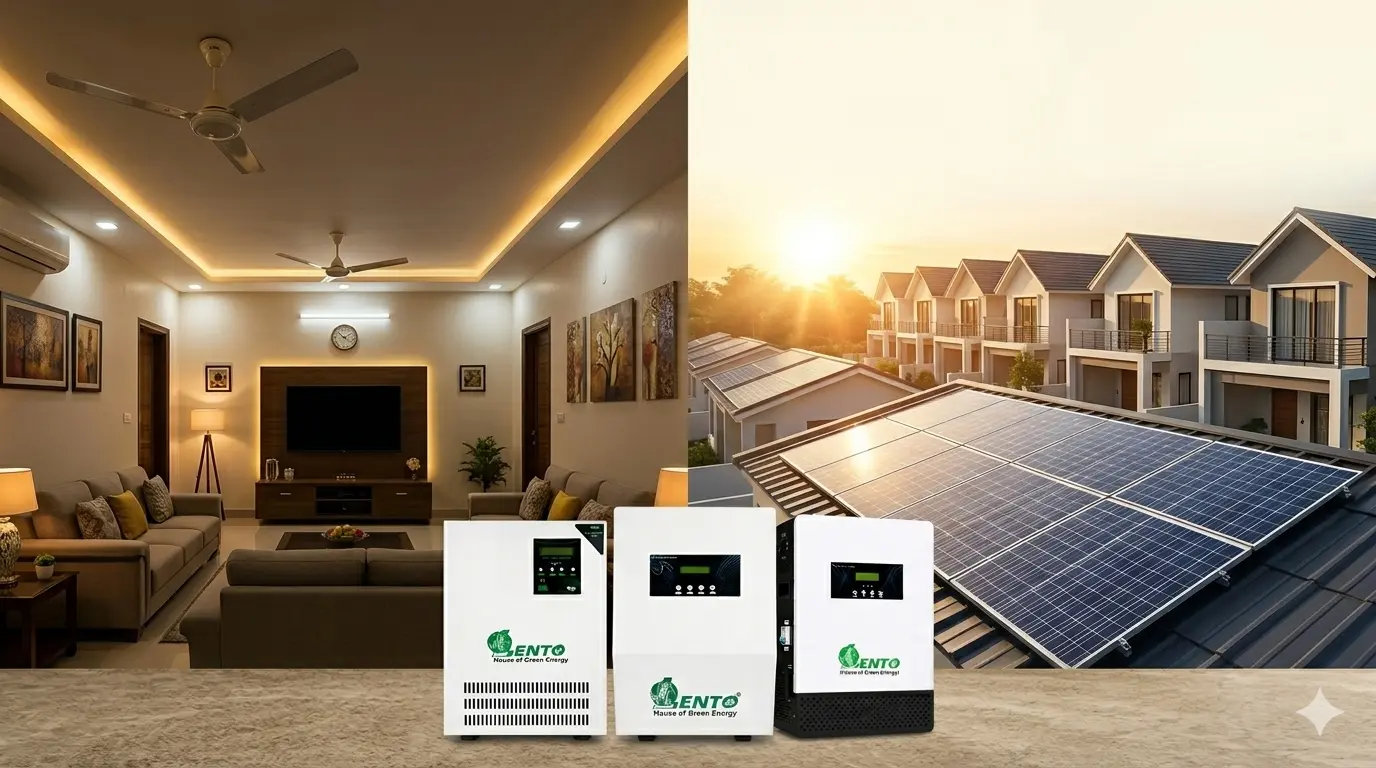
Inverter Capacity for 200Ah Battery: Formula, Chart & Calculator
13 October 2026
Quick answer: The right inverter capacity for 200Ah battery is set by your load, not the battery. For most homes it is 800 VA to 1.1 kVA on a 12V system. Use this formula: Inverter VA = (running load in watts × 1.25) ÷ 0.8. For loads above about 800W, move to 24V with two batteries, and for solar, choose a hybrid MPPT inverter.
Buy a Lento inverter from the official Lento website or on Amazon India, then size it with the tools below.
The 3-Line Formula
- Add your running load in watts (W).
- Add 25% headroom (multiply by 1.25) so the inverter doesn’t run at its limit.
- Convert watts to VA by dividing by 0.8, which is the typical power factor for home inverters.
Inverter capacity (VA) = (Running load in W × 1.25) ÷ 0.8
Then round up to the next standard size: 800 VA, 1 kVA, 1.1 kVA, 1.5 kVA, 2 kVA, and so on.
Inverter Capacity for 200Ah Battery: The Cheat Sheet
This chart shows the largest inverter each battery bank can sensibly support. “Comfortable” keeps battery stress low for longer life, and “maximum” is the practical ceiling for short backup.
| Battery bank | System voltage | Stored energy | Comfortable capacity (tubular) | Maximum capacity (tubular) | Lithium (LiFePO4) |
|---|---|---|---|---|---|
| One 12V 200Ah | 12V | about 2,400 Wh | up to about 500 VA | about 1–1.1 kVA | about 1.5 kVA, if the BMS allows |
| Two 12V 200Ah in series | 24V | about 4,800 Wh | up to about 1 kVA | about 2 kVA | about 3 kVA, if the BMS allows |
| Four 12V 200Ah in series | 48V | about 9,600 Wh | up to about 2 kVA | about 3–4 kVA | about 5 kVA, if the BMS allows |
How to read it: the “comfortable” column is for good battery life, and the “maximum” column is the upper limit. Running at the maximum shortens backup and battery life, because heavy discharge cuts usable capacity. Connecting batteries in parallel keeps the voltage the same and doubles the Ah, so check what your inverter supports. One forum discussion notes that series or parallel wiring is dictated by the inverter’s specification. These are rules of thumb, so confirm the exact limits in your battery’s datasheet. team-bhp
Calculator Walkthrough: Size Your Inverter in 5 Steps
Step 1: List Your Appliances
Typical wattages are below, but check each appliance’s label. Newer BLDC fans use only about 30–35W.
| Appliance | Typical watts | Qty | Total |
|---|---|---|---|
| Ceiling fan | 70W | 2 | 140W |
| LED bulb | 10W | 5 | 50W |
| Wi-Fi router | 15W | 1 | 15W |
| LED TV | 100W | 1 | 100W |
| Laptop charger | 65W | 1 | 65W |
| Refrigerator (running) | 150W | 1 | 150W |
| Running total | 520W |
Step 2: Apply the Formula
(520W × 1.25) ÷ 0.8 = 650 ÷ 0.8 = about 812 VA
Step 3: Round Up
The next standard size is 1 kVA. If you plan to add more appliances later, choose 1.1 kVA.
Step 4: Check the Battery Current
Current from a 12V battery is roughly watts ÷ (12 × 0.85).
- 520W gives about 51A.
- 800W gives about 78A.
- 1,000W gives about 98A.
A 200Ah tubular battery handles 50A comfortably for short backup. Above about 80A, usable capacity and battery life drop noticeably.
Step 5: Pick the Bank Voltage
- Running load up to about 800W: 12V, one battery.
- Running load above about 800W: 24V, two batteries in series.
- Running load above about 2,000W: consider 48V.
Never mix voltages. The inverter’s rated battery voltage must match the battery bank.
Quick Lookup: Capacity by Appliance Bundle
| Bundle | Running load | Formula result | Suggested capacity (12V) |
|---|---|---|---|
| Essentials: 2 fans, 4 LEDs, router, phone charger | about 200W | about 310 VA | 800 VA (smallest common size) |
| Comfort: essentials plus TV and laptop | about 370W | about 580 VA | 800 VA to 1 kVA |
| With fridge: comfort plus refrigerator | about 520W | about 810 VA | 1 kVA |
| Work-from-home family: with fridge plus a second laptop | about 590W | about 920 VA | 1.1 kVA |
| Motor loads: water pump, mixer, heavy fridge | check the label | needs surge allowance | 1.5 kVA and above, usually 24V |
Surge warning: motors and compressors draw several times their running power for a moment when they start. If an appliance has a motor, check its starting rating and make sure the inverter’s surge capacity covers it.
Inverter Capacity for 200Ah Battery vs Backup Time
Backup depends on the load and the battery, not the inverter’s VA rating. These estimates assume about 85% inverter efficiency, about 50% usable capacity for tubular, and about 90% for lithium.
| Load | 12V tubular | 12V lithium | 24V tubular | 24V lithium |
|---|---|---|---|---|
| 200W | about 5 h | about 10 h | about 10 h | about 20 h |
| 400W | about 2.5 h | about 5 h | about 5 h | about 10 h |
| 800W | about 1.3 h | about 2.5 h | about 2.5 h | about 5 h |
| 1,000W | about 1 h | about 2 h | about 2 h | about 4 h |
| 1,500W | about 40 min | about 1.4 h | about 1.4 h | about 2.7 h |
| 2,000W | not suitable | not suitable | about 1 h | about 2 h |
These are estimates only. Real backup depends on battery age, temperature, and how the load changes. For the energy maths behind this, read our guide on the best inverter with battery for home.
What Happens If the Capacity Is Wrong?
| Problem | Too small | Too large |
|---|---|---|
| Overload trips | Frequent shutdowns | Rare |
| Battery stress | Not applicable | Not an issue if the load stays small |
| Idle power use | Low | Higher, wasting battery at night |
| Cost | Lower, but may need replacing | Higher upfront |
| Risk | Damage from repeated overload | Wasted money, or heavy loads later that overdraw the battery |
The best fit is an inverter slightly above your load, with your battery bank sized to match.
12V vs 24V vs 48V: Which Capacity Band Fits?
| System | Best for | Why |
|---|---|---|
| 12V | Up to about 1.1 kVA | One battery, simple and low cost |
| 24V | About 1.5–3 kVA | Half the current of 12V for the same power, so less heat and voltage drop |
| 48V | About 3 kVA and above | Lowest current, best for large homes and shops |
Higher voltage lets you run bigger loads with thinner cables and less battery stress.
Match the Inverter Type to Your Capacity
Pure Sine Wave Inverters
A pure sine wave inverter is the default choice for home capacities from 800 VA to 2 kVA, giving smooth power for fans, TVs, and fridges.
Hybrid Solar Inverters
A hybrid solar inverter uses solar, grid, and battery together.
- An MPPT solar inverter suits larger panel arrays.
- A PWM household solar inverter suits small, budget setups.
- An off-grid MPPT solar inverter suits weak-grid areas.
Industrial Inverters
For shops and workshops, see the single-phase industrial inverter and the three-phase industrial inverter. These loads usually need 24V or 48V.
Inbuilt Lithium Inverters
For a matched inverter-and-battery package, see Lento’s sine wave inverter with inbuilt lithium battery, which removes most of the compatibility guesswork.
Lento Inverters by Capacity Band
Amazon listings show indicative prices like these. Some are inverter-plus-battery packages, so confirm what is included before comparing prices.
| Capacity band | Lento model | Indicative price |
|---|---|---|
| About 1 kVA, 12V | 1.1 kVA 12.8V lithium inverter | about ₹27,300–₹29,700 |
| About 2 kVA, 24V | 2.1 kVA 25.6V lithium inverter UPS | about ₹44,100–₹53,700 |
| About 2.5 kVA, 24V solar | 2.5 kVA 24V solar hybrid inverter (MPPT) | about ₹24,000 |
| About 5 kVA, 48V solar | 5 kVA 48V solar hybrid PCU (MPPT) | about ₹47,000 lento 1 1kva 12 8v lithium 8C1kjsG5 +3 |
More options: the hybrid solar inverter with inbuilt lithium battery (PWM), the hybrid solar inverter with inbuilt lithium battery (MPPT), and the on-grid solar inverter.
Care Tips That Protect Your Capacity
- Don’t run the inverter near its maximum rating for long.
- Keep the inverter and battery in a dry, ventilated, shaded spot.
- Keep terminals clean and tight, and use correctly rated cables and fuses.
- Top up tubular batteries with distilled water as the maker advises.
- Don’t drain a lead-acid battery to zero.
- If the inverter acts up, read how to reset an inverter safely.
B2B and Export
Lento India manufactures inverters and supplies 24+ countries. For bulk orders, distributorship, or commercial projects, contact the team through the Lento website.
The Bottom Line
The inverter capacity for 200Ah battery you need comes from one formula: (running load × 1.25) ÷ 0.8. For most homes that is 800 VA to 1.1 kVA on 12V. For loads above about 800W, use 24V, and for solar, a hybrid MPPT inverter. Add your loads, check the surge on motors, and choose the voltage before you buy. Lento’s range covers pure sine wave, hybrid solar, lithium, and industrial capacities. Ready to buy? Visit the official Lento website or check Lento on Amazon India.
Frequently Asked Questions
1. What size inverter do I need for a 200Ah battery?
A 900VA–1500VA pure sine wave inverter may suit typical home loads with a compatible 12V, 200Ah battery. Choose the capacity according to your total appliance load and starting power requirements.
2. Can I use a 1500W inverter with a 200Ah battery?
Yes, if the battery voltage and discharge rating support the load. A 12V, 200Ah battery may need to supply over 125A at 1500W after accounting for inverter losses, so check the battery's specifications.
3. Can I use a 2000W inverter with a 200Ah battery?
Yes, provided the battery supports the required current and is compatible with the inverter. At 12V, a 2000W load can draw over 180A after inverter losses, which may exceed some batteries' discharge limits.
4. Which inverter is suitable for a 200Ah battery?
A pure sine wave inverter with the correct battery voltage and charging compatibility is suitable for most home applications. Lento offers home and solar inverter options; select the model based on your appliances and backup needs.
5. What is the maximum load capacity of a 200Ah battery?
A 200Ah rating indicates battery capacity, not maximum load in watts. Maximum load depends on battery voltage, chemistry, discharge-current limit and inverter efficiency; check the battery manufacturer's specifications.
6. How long can a 150Ah battery run a load of 600 watts?
A 12V, 150Ah battery stores approximately 1,800Wh of nominal energy. At a 600W load, the theoretical runtime is about 3 hours, but actual backup will be shorter due to inverter losses and usable battery capacity.
Related Reading: Size It, Store It, Charge It
Pick the right capacity
- Best inverter for home in India: sizing by home type
- Best inverter with battery for home: matching capacity to battery
Upgrade to lithium
- Best lithium inverter for home: capacity and backup compared
- Inverter with inbuilt lithium battery for home
- Lithium inverter for home: how it works
Go solar and keep it running