
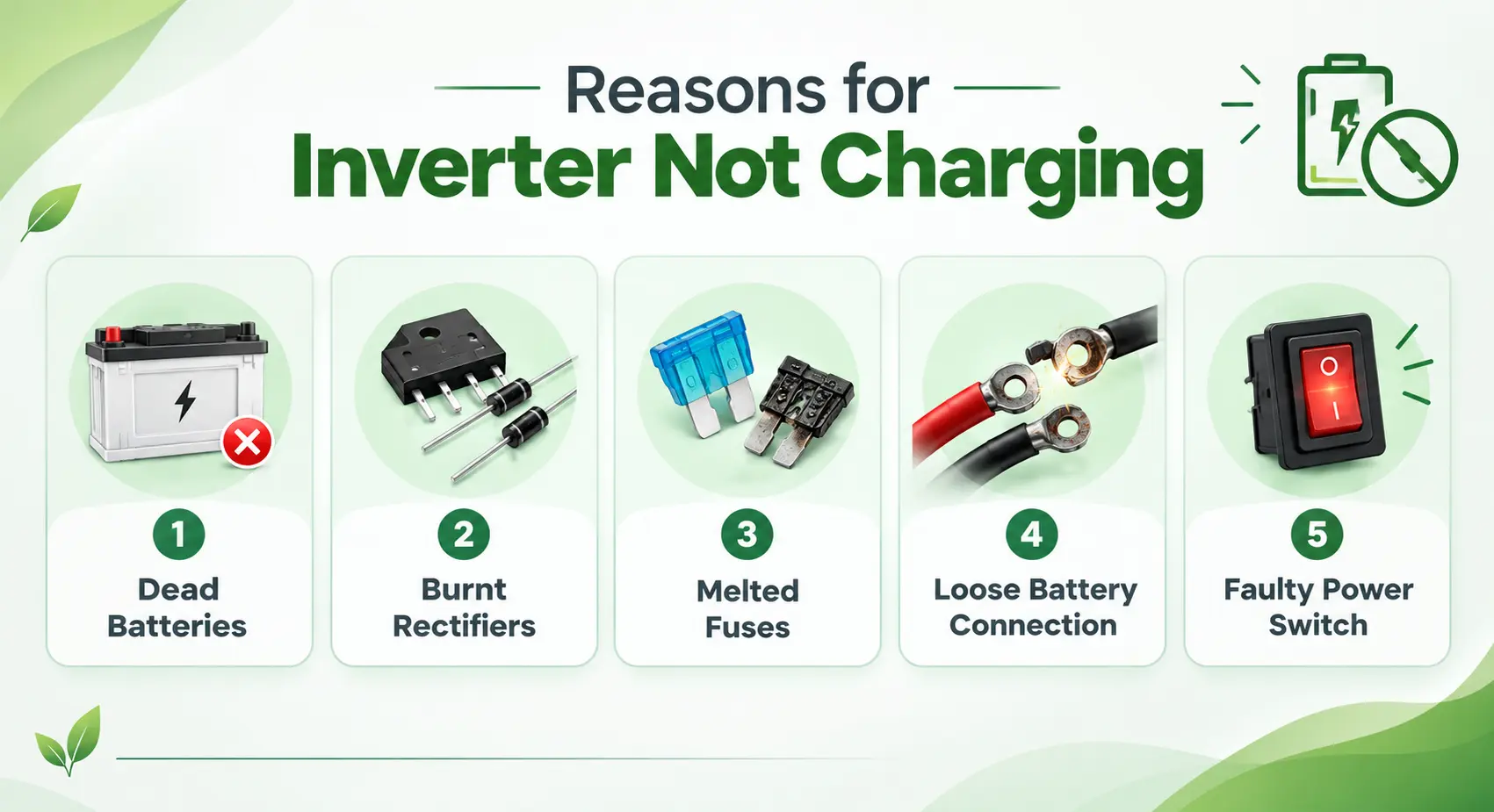
Here Are the Possible Reasons Why Inverter Is Not Charging
15 October 2026
Quick Answer: Why Is My Inverter Not Charging?
An inverter is not charging when the mains voltage is too low, the battery is weak or sulphated, terminals are loose or corroded, settings are wrong, the load is too heavy, the unit is overheating, the solar side has failed, or the internal charging circuit is damaged. Check the mains supply, battery, and wiring first, because they cause most charging problems.
What Does “Inverter Not Charging” Mean?
An inverter not charging means the unit is not sending charge to the battery even though mains power is available. It is also searched as inverter battery not charging, inverter not charging battery, or simply battery not charging.
Signs of an inverter charging problem:
- Backup time is much shorter than before
- The battery level doesn’t rise with mains on
- The charging light is off or blinking
- Frequent low-battery alarms
- Heat, buzzing, or a burning smell
- Error codes on the display
Here Are the Possible Reasons Why Inverter Is Not Charging
1. Low or Unstable Mains Voltage
Short answer: If input voltage falls below the inverter’s minimum charging level, the inverter keeps running but stops charging the battery.
This is the most overlooked cause of an inverter battery charging problem. Peak-hour voltage drops, fluctuations, and short supply windows all affect the charger.
Check: Read input voltage on the display or with a multimeter and compare it with your manual.
Fix: Use a suitable voltage stabilizer and avoid heavy loads when the grid is weak.
2. Aged, Weak, or Sulphated Battery
Short answer: A degraded battery can refuse to accept charge, which makes the inverter look faulty.
Most inverter battery problem reports trace back to the battery. Plates wear, electrolyte drops, and capacity falls, which is a typical inverter battery fault. If your inverter battery is not getting charged, start here.
Common causes:
- Low water in tubular batteries
- Sulphation from long undercharging
- Internal short circuit or physical damage
- Battery capacity too small for the load
Fix: Top up distilled water, clean terminals, and test voltage. If the battery is four to five years old and keeps failing, replacement usually beats repeated inverter battery repair.
Helpful Lento resources:
- How to revive a dead tubular battery at home
- Can you revive a completely dead battery?
- Tubular batteries | SMF batteries
- 150Ah battery backup time calculator
3. Loose, Corroded, or Reversed Connections
Short answer: Poor connections add resistance and restrict charging current without shutting the inverter down.
Corrosion, loose lugs, thin cables, and wrong polarity are common hidden causes of a battery charging issue.
Safe steps:
- Switch off the inverter and disconnect mains
- Disconnect the battery terminals
- Clean corrosion with a wire brush and baking soda solution
- Reconnect firmly with correct polarity (+ to +, − to −)
- Make sure the cable thickness suits the inverter rating
4. Incorrect Battery Type or Charging Mode
Short answer: The wrong battery-type setting changes charging voltage and current, and can reduce or stop charging.
Choosing SMF while using tubular batteries is a classic mistake.
How to fix inverter charging problem caused by settings:
- Confirm the battery type (tubular, SMF, lithium)
- Check the charging current limit
- Reset to factory defaults if unsure, then reconfigure
5. Overloaded Inverter
Short answer: Heavy loads use up available power and leave too little current for charging.
This is common when grid supply is available only for short periods. Switch off non-essential appliances while the battery charges.
6. Overheating and Poor Ventilation
Short answer: High temperatures trigger thermal protection that pauses charging.
Dust, direct sun, and cramped spaces cause many inverter fault cases. Keep the inverter and batteries in a cool, dry, ventilated area.
7. Blown Fuse, Tripped Breaker, or Faulty Input
Short answer: A blown fuse or tripped input breaker can cut mains power to the charger while the inverter still runs on battery.
Check the breaker, plug, and fuse. Replace a fuse only with the same rating, and if it blows again, get the unit inspected.
8. Solar Panel or Charge Controller Problems
Short answer: Dirty panels, shading, damaged cables, or a faulty charge controller can stop charging even in bright sunlight.
Inspect panels, cables, and controller settings (MPPT or PWM). See Lento’s solar panels, solar charge controllers, and solar hybrid inverters.
9. Mismatched or Mixed Batteries
Short answer: Mixing old and new batteries, or using the wrong capacity, leads to uneven charging.
Use matched batteries of the same type, age, and capacity. Size the bank properly with the backup time calculator.
10. Charging Circuit or Control Board Failure
Short answer: If power, battery, wiring, and settings are all fine, the internal charger has probably failed.
Overheating, dust, voltage spikes, and aging parts can damage it. This is the most serious inverter fault, and running the unit can make the damage worse. Compare repair cost with replacement, especially for older units. Explore Lento’s inverters and Online UPS systems.
Inverter Troubleshooting Checklist
| Step | Check | Healthy result |
|---|---|---|
| 1 | Mains voltage | Within input range, stable |
| 2 | Input breaker and fuse | Intact, not tripped |
| 3 | Battery age and water level | Under 4–5 years, correct level |
| 4 | Terminals and cables | Clean, tight, correct polarity |
| 5 | Battery type setting | Matches installed battery |
| 6 | Connected load | Not overloaded while charging |
| 7 | Temperature and ventilation | Cool, dry, dust-free |
| 8 | Solar panels and controller | Clean, unshaded, working |
| 9 | Error codes | None, or explained in the manual |
Call a technician immediately if you see smoke, notice a burning smell, or find a swollen battery casing.
Symptom-Based Quick Diagnosis
| What you notice | Most likely cause |
|---|---|
| Charging stops at peak hours | Low mains voltage |
| Short backup, warm battery | Aged or sulphated battery |
| Charging on and off | Loose or corroded terminals |
| Poor charging after a battery change | Wrong battery-type setting |
| No charging in daytime (solar) | Panel or charge controller fault |
| All checks pass, still no charge | Charging circuit failure |
Repair or Replace?
| Situation | Best option |
|---|---|
| Low water, dirty terminals | Basic maintenance |
| Mild sulphation | Try reviving, then retest |
| Battery over 4–5 years, weak backup | Replace the battery |
| Failed charger on an old inverter | Replace the inverter |
| Failed charger on a newer inverter | Professional repair |
How to Prevent Charging Problems
- Check tubular battery water every 3 to 4 months
- Keep terminals clean and tight
- Match battery capacity to your load
- Use a stabilizer in low-voltage areas
- Install in a ventilated, dust-free space
- Book periodic professional inspections
Frequently Asked Questions
1. What are the possible reasons why my inverter isn't charging?
Common reasons include loose battery connections, a faulty charging circuit, low mains voltage, incorrect battery settings, a blown fuse, or a damaged battery. In solar inverters, insufficient solar power or a charge controller issue may also prevent charging.
2. How to repair a dead inverter battery?
First, check the charger, terminals, and battery connections. If the battery is deeply discharged, it may recover with a compatible charger and the manufacturer's recommended charging procedure. If it still fails to charge or hold power, get it tested by a technician. Replace it if the internal damage is irreversible.
3. Does an inverter stop charging when the battery is full?
Yes, most modern inverters automatically reduce or stop bulk charging when the battery reaches its target charge level. Some use a float-charging mode to maintain the charge. The exact behaviour depends on the inverter and battery type.
4. Why is my battery suddenly not charging?
A battery may suddenly stop charging because of a faulty charger, loose wiring, a blown fuse, a power supply problem, a failed battery cell, or a battery management system (BMS) safety cutoff in lithium batteries. Check the visible connections and error indicators, then seek professional testing if the issue persists.
5. Why is my inverter showing mains power but not charging the battery?
The inverter may be receiving electricity but have a fault in its charging circuit, incorrect charging settings, or a battery that cannot accept a charge. A qualified technician can check the input voltage, charging output, and battery condition.
6. Why is my inverter charging light not blinking?
The charging light may remain off when the battery is full, charging is disabled, or the inverter has detected a fault. Check the user manual for your model's indicator meanings before assuming the battery is damaged.
Key Takeaways
- An inverter not charging usually comes from the grid, battery, wiring, settings, load, heat, solar side, or internal charger
- Check the simple causes first: voltage, terminals, water level, and settings
- A battery over four to five years old is the most frequent inverter battery fault
- A failed charging circuit needs professional diagnosis
- Regular maintenance prevents most battery charging problems
About Lento India – Global B2B Solar Exporter
Lento India exports solar and power solutions to 24 countries, including Mexico, Chile, Peru, Ecuador, Dominican Republic, Afghanistan, Nigeria, Iraq, Uganda, Yemen, Syria, Iran, Oman, Morocco, Egypt, and Kuwait. It supplies solar panels, tubular batteries, SMF batteries, inverters, and Online UPS systems to distributors, OEMs, and large-scale installers.
Share your requirements through the Lento contact form, and the export team will respond within 24 hours.
Become our distributor in your state.