
Will a 5kW Solar System Run a House? Capacity, Appliances & Battery Guide
16 October 2026
Table of Contents
- Quick Answer
- Key Takeaways
- How Much Power Does a 5kW Solar System Produce?
- What Can a 5kW Solar System Run?
- Will a 5kW Solar System Run a House Without Electricity From the Grid?
- On-Grid vs Off-Grid vs Hybrid: Which Works Best?
- How to Calculate Whether 5kW Is Enough for Your Home
- Battery Size Needed for a 5kW Solar System
- Common Solar Inverter Issues: Red Light, Fault and Warning Signals
- Tips to Get the Most From a 5kW System
- Why Choose Lento Solar Inverters?
- FAQs
- Conclusion
Quick Answer
Yes. A 5kW solar system can run an average Indian home in most cases. It typically generates around 18–22 units (kWh) per day, which is roughly 550–650 units per month in good sunlight. That covers lights, fans, TV, fridge, a washing machine, and one or two air conditioners for many 2–3 BHK homes. Heavy users with several ACs, a geyser, and an electric cooktop may need more capacity or must stay connected to the grid.
Key Takeaways
- A 5kW solar system usually produces about 18–22 kWh per day, depending on location, season, and panel condition.
- Most 2–3 BHK homes use roughly 250–500 units per month, so 5kW often covers all of it.
- Running at night needs batteries (off-grid or hybrid) or the grid (on-grid).
- A 5kW system is not the same as a 5kVA inverter. Panel capacity (kW) and inverter size (kVA) are different ratings.
- Regular cleaning and a healthy battery prevent most inverter issues, including the inverter red light problem.
How Much Power Does a 5kW Solar System Produce?
Daily output depends on peak sun hours. India gets roughly 4–6 peak sun hours a day in most regions.
Simple formula: System size (kW) × peak sun hours × 0.75–0.8 efficiency = daily units (kWh)
Example: 5 kW × 5 hours × 0.8 = about 20 kWh per day
| Season | Typical daily output (5kW) | Approx. monthly units |
|---|---|---|
| Summer (clear sky) | 20–24 kWh | 600–720 |
| Monsoon (cloudy) | 12–16 kWh | 360–480 |
| Winter | 16–20 kWh | 480–600 |
These are estimates. Shading, dust, tilt angle, and panel quality change the real figure.
What Can a 5kW Solar System Run?
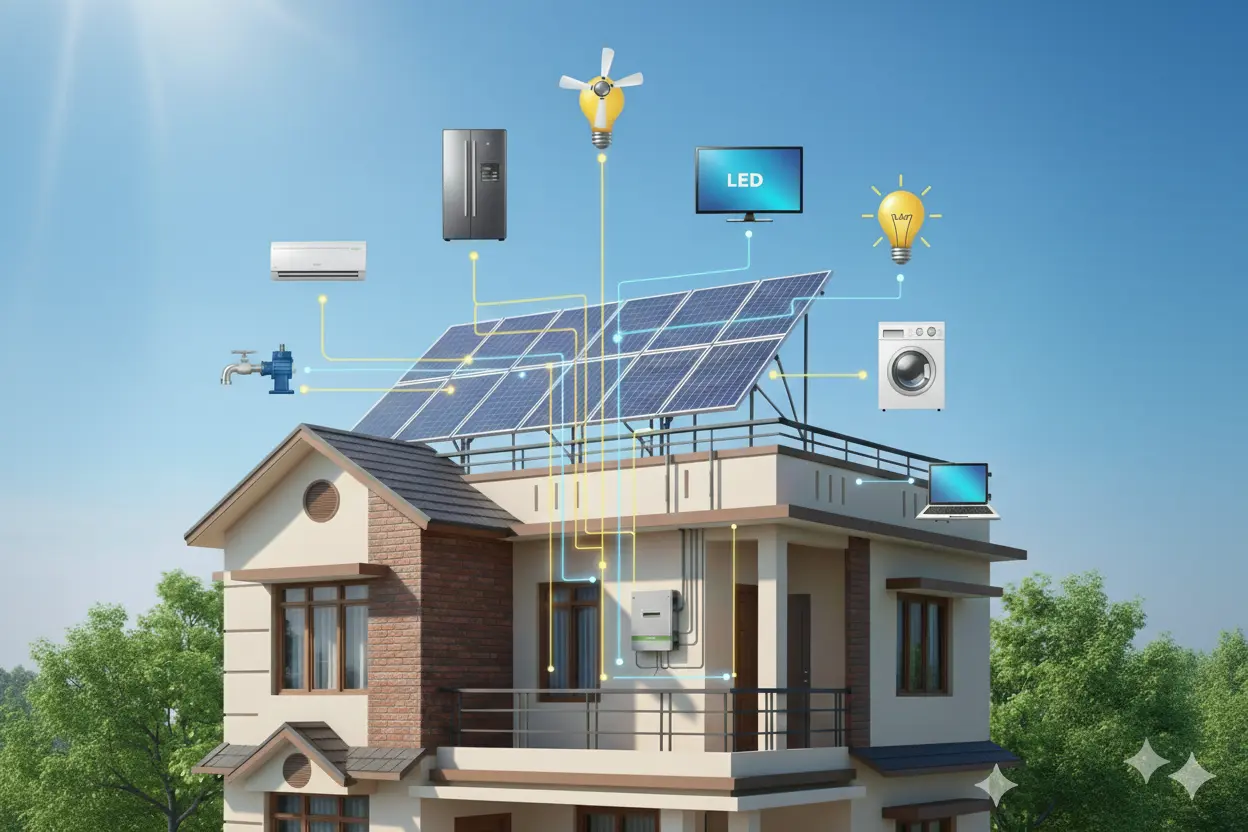
A 5kW system can power most household appliances in daylight, provided the total running load stays within the inverter’s capacity.
| Appliance | Approx. running load |
|---|---|
| LED lights (10 bulbs) | 100 W |
| Ceiling fans (4) | 300 W |
| Refrigerator | 150–250 W |
| LED TV | 80–120 W |
| Washing machine | 500 W |
| Water pump (0.5–1 HP) | 400–750 W |
| 1.5-ton inverter AC | 1,000–1,500 W |
| Geyser | 2,000 W |
For a deeper look at air conditioners, read our guide on the best inverter to run an air conditioner.
Will a 5kW Solar System Run a House Without Electricity From the Grid?
It can, but only with a battery bank. Solar panels produce power only when the sun shines. Without batteries, an off-grid house loses power at night and on cloudy days.
- With batteries (off-grid or hybrid): the system stores extra daytime energy and supplies it at night.
- Without batteries (on-grid): the house uses solar during the day and draws from the grid at night. During a power cut, a standard on-grid system shuts down for safety.
A well-sized battery bank with a hybrid inverter gives the closest experience to full grid independence.
On-Grid vs Off-Grid vs Hybrid: Which Works Best?
| Feature | On-Grid | Off-Grid | Hybrid |
|---|---|---|---|
| Needs grid connection | Yes | No | Optional |
| Works during power cut | No | Yes | Yes |
| Needs batteries | No | Yes | Yes |
| Can reduce electricity bill | Yes | Limited | Yes |
| Best for | Cities with stable grid | Remote areas | Homes with frequent outages |
Most homes with regular outages choose a hybrid system. Learn more in our guide on which type of solar inverter is right for you, and see inverters with battery for home.
How to Calculate Whether 5kW Is Enough for Your Home
Follow these four steps.
- Check your monthly units. Look at your electricity bill. Divide by 30 for daily use.
- List your appliances. Note wattage and hours used per day.
- Add up daily energy. Wattage × hours ÷ 1,000 = kWh per appliance.
- Compare with solar output. A 5kW system giving about 20 kWh per day covers homes using up to about 600 units per month.
Example: A home using 400 units per month needs about 13 units per day. A 5kW system comfortably covers it, with surplus in sunny months.
Battery Size Needed for a 5kW Solar System
Battery size depends on how much you want to run at night.
Backup time (hours) = (Battery voltage × Capacity in Ah × Efficiency) ÷ Load in watts
Example: A 48V, 200Ah battery bank stores about 9.6 kWh. With 80% usable capacity, you get roughly 7.7 kWh. A 500W night load would then run for about 15 hours.
A 5kW system with 5kVA 48V inverter often pairs with:
- 4 × 12V 200Ah tubular batteries (48V bank), or
- A matching 48V lithium battery
See our guides on how many 200Ah batteries a 3kVA inverter needs, the tubular battery, and the best inverter battery for home.
Common Solar Inverter Issues: Red Light, Fault and Warning Signals
Even a well-sized 5kW system can show inverter issues over time. Knowing the inverter red light meaning helps you act quickly.
| Signal | Likely meaning | What to do |
|---|---|---|
| Solid inverter red light | Active inverter fault such as low battery or overload | Reduce load, check battery voltage |
| Inverter red light blinking | Specific inverter error light code | Check the manual for the blink pattern |
| Inverter alarm (beeping) | Overload, low battery, or overheating | Switch off heavy loads, let the unit cool |
| Inverter warning light with no output | Low solar input or charging problem | Clean panels, check connectors |
How to fix inverter red light problems: switch off the load, check battery voltage and terminals, clean the panels, confirm settings, and restart. If the inverter fault light returns, book inverter repair with an authorised service centre.
Read more in our guides on why your inverter shows a red light and how long an inverter battery lasts.
Tips to Get the Most From a 5kW System
- Clean the panels regularly, especially in dusty areas.
- Shift heavy loads like washing machines and pumps to daytime hours.
- Avoid shading from trees, tanks, and nearby buildings.
- Keep terminals tight and clean. See our battery maintenance guide.
- Use energy-efficient appliances such as inverter ACs and LED lights.
- Place the inverter in a cool, ventilated area.
Why Choose Lento Solar Inverters?
Lento India manufactures pure sine wave inverters, hybrid solar inverters, Online UPS systems, solar panels, and batteries for homes and businesses. Lento inverters offer overload and short-circuit protection and work with tubular, SMF, lithium, and solar batteries.
Explore the best inverter for home use, the power inverter buying guide, or a space-saving wall-mounted inverter. Lento exports to 24 countries. See the No. 1 inverter battery company in India for dealer and bulk options.
FAQs: 5kW Solar System
Will a 5kW solar system run a house?
Yes, for most 2–3 BHK homes. It generates about 18–22 units per day, which covers typical household use, including one or two ACs in daylight.
How many units does a 5kW solar system produce per month?
Roughly 550–650 units in good sunlight. Cloudy months can drop to 360–480 units.
Can a 5kW solar system run an air conditioner?
Yes. It can run one or two inverter ACs in daylight. At night, you need a battery bank sized for the AC load.
Can a 5kW solar system run a house at night?
Only with batteries or a grid connection. A hybrid system with a battery bank is the most common option.
How many batteries does a 5kW solar system need?
It depends on night load. A common setup is a 48V bank, such as four 12V 200Ah batteries, giving roughly 9.6 kWh of storage.
Is a 5kW solar system the same as a 5kVA inverter?
No. kW rates panel capacity or real power, while kVA rates inverter apparent power. A 5kW array commonly pairs with a 5kVA inverter.
How much roof space does a 5kW solar system need?
Roughly 30–40 square metres (about 320–430 sq ft), depending on panel wattage and layout.
What does the red light on a solar inverter mean?
The inverter red light signals a fault such as low battery, overload, or low solar input. A blinking red light shows a specific error code in your manual.
Should I repair or replace an inverter that keeps showing a fault light?
Start with the basics: battery, wiring, and load. If the inverter fault continues, get professional inverter repair before deciding on replacement.
Conclusion
A 5kW solar system can run a typical Indian house, covering around 550–650 units per month in good sunlight. Daytime use is simple. Night-time backup needs batteries or a grid connection. Size the system using your own bills and appliance list, pick the right inverter type, and maintain the battery and panels. If an inverter red light or inverter alarm appears, follow the troubleshooting steps above, and call for inverter repair when needed.
Read More
What Can a 5kW Solar System Run A Complete Practical Guide
Which Brand Tubular Battery Is Best? Buying Guide for Indian Homes
How to Revive a Dead Tubular Battery
Can You Revive a Completely Dead Battery?
How to Revive a Dead Tubular Battery at Home: Safe Step-by-Step Guide
Top 10 Inverter Batteries in India: Best Tubular, SMF and Lithium Options for Home Backup
150Ah Battery Backup Time Calculator: How Many Hours Will It Run? (Formula + Chart)
Inverter Capacity for 200Ah Battery: Formula, Chart & Calculator
Suitable Inverter for 200Ah Battery: The 6-Point Compatibility Guide