Top 10 inverter battery for home : Best Tubular, SMF and Lithium Options
14 October 2026
Top 10 Inverter Batteries for Home in India: The List
- Lento Lead Acid Tubular Battery (C10 / C20)
- Loom Solar Battery (150Ah)
- Exide InvaMaster IMTT1500
- Luminous Inverlast ILTT 18060
- Amaron Current AR150TN54
- Livguard IT1560STT
- Okaya Hadi OPHT18060
- Eastman EM16060TT
- Genus Hallabol GTT170
- V-Guard VT 160
This is a comparison list, not an official ranking. Models, prices and warranty terms vary by year and region.
What Is an Inverter Battery?
An inverter battery stores electricity and supplies it to your home through an inverter when the grid fails. Unlike a car battery, it is built for slow, deep discharge and repeated charging. Three types are sold in India:
| Type | How it works | Maintenance | Best for |
|---|---|---|---|
| Tubular (flooded lead-acid) | Tubular positive plates, liquid electrolyte | Periodic distilled water top-up | Frequent, long power cuts |
| SMF / VRLA (sealed) | Sealed, valve-regulated design | None | Low-maintenance homes, UPS and solar use |
| Lithium (LiFePO4) | Lithium iron phosphate cells | None | Long life, compact space, daily cycling |
If you want a sealed, maintenance-free option, explore the Lento SMF VRLA monoblock battery.
Top 10 Inverter Batteries at a Glance
| Rank | Brand and model | Capacity | Warranty (total / free replacement)* | Best for |
|---|---|---|---|---|
| 1 | Lento Lead Acid Tubular (C10 / C20) | 50Ah to 320Ah | Confirm per model | Wide capacity choice, home to commercial |
| 2 | Loom Solar | 150Ah | 66 / 48 months | Long, frequent power cuts |
| 3 | Exide InvaMaster IMTT1500 | 150Ah | 60 / 36 months | Premium-segment value |
| 4 | Luminous Inverlast ILTT 18060 | 150Ah | 60 / 36 months | Better charge acceptance |
| 5 | Amaron Current AR150TN54 | 150Ah | 54 / 36 months | Low maintenance |
| 6 | Livguard IT1560STT | 150Ah (C20) | 60 / 36 months | Fast charging |
| 7 | Okaya Hadi OPHT18060 | 150Ah | 60 / 36 months | Homes, shops, offices |
| 8 | Eastman EM16060TT | 160Ah | 60 / 36 months | Budget-friendly backup |
| 9 | Genus Hallabol GTT170 | 150Ah (C20) | 60 / 30 months | Heavy, regular loads |
| 10 | V-Guard VT 160 | 150Ah | 48 / 30 months | Pairing with V-Guard UPS |
*Warranty figures come from published brand information and can change by model year and region. Verify with your seller before buying.
The Top 10 Inverter Batteries for Home, Reviewed
1. Lento Lead Acid Tubular Battery (C10 and C20)
Best for: buyers who want one brand covering home, clinic, commercial and solar needs.
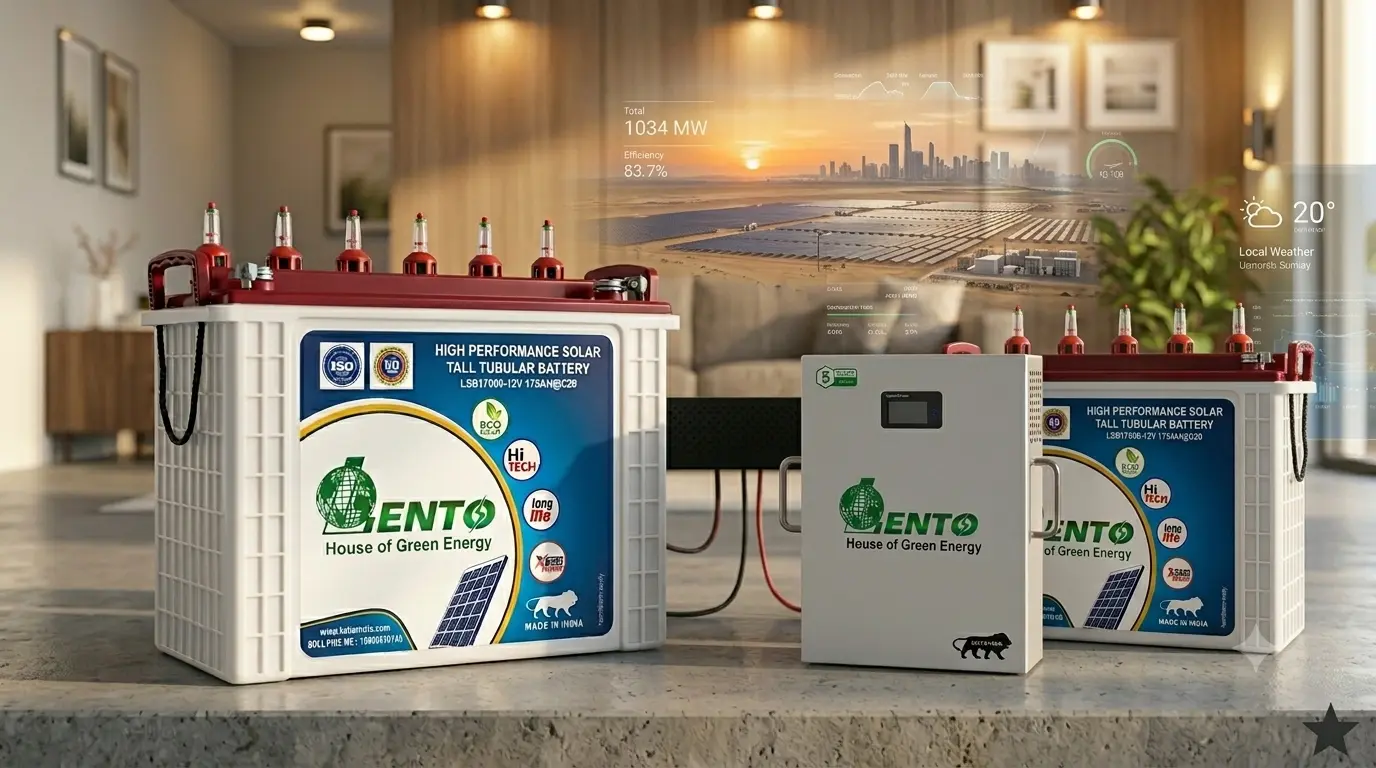
Lento offers tubular batteries in both C10 and C20 ratings from 50Ah to 320Ah, so you can compare like for like. Check the C10 tubular battery range for heavy or commercial loads and the C20 tubular battery range for regular household loads.
2. Loom Solar (150Ah)
Best for: long and frequent power cuts.
A tall tubular battery with a long total warranty of 66 months, including 48 months of free replacement.
3. Exide InvaMaster IMTT1500 (150Ah)
Best for: premium-segment value.
A tall tubular battery with faster charging, high backup and deep-discharge capability. Warranty is 60 months, with 36 months of free replacement.
4. Luminous Inverlast ILTT 18060 (150Ah)
Best for: homes needing better charge acceptance.
It uses a corrosion-resistant spine alloy and oxidation-resistant gauntlets, with level indicators for easy maintenance. Warranty is 60 months, with 36 months of free replacement.
5. Amaron Current AR150TN54 (150Ah)
Best for: low-maintenance use.
A heat-resistant calcium hybrid alloy grid reduces water loss and corrosion. Warranty is 54 months, with 36 months of free replacement.
6. Livguard IT1560STT (150Ah, C20)
Best for: fast charging and frequent discharges at home, office or shop.
Warranty is 60 months, with 36 months of free replacement.
7. Okaya Hadi OPHT18060 (150Ah)
Best for: homes, shops and offices with long, frequent cuts.
Warranty is 60 months, with 36 months of free replacement.
8. Eastman EM16060TT (160Ah)
Best for: affordable, steady backup.
Vent plugs reduce acid fumes, and the battery needs little water top-up. Warranty is 60 months, with 36 months of free replacement.
9. Genus Hallabol GTT170 (150Ah, C20)
Best for: regular heavy loads.
Higher acid volume means less frequent maintenance. Warranty is 60 months, with 30 months of free replacement.
10. V-Guard VT 160 (150Ah)
Best for: homes with a V-Guard digital UPS.
It also works with other UPS systems. Warranty is 48 months, with 30 months of free replacement.
C10 vs C20 Rating: How to Compare Inverter Batteries Fairly
Battery capacity (Ah) depends on how long the discharge test runs.
| Feature | C10 rating | C20 rating |
|---|---|---|
| Measured over | 10-hour discharge | 20-hour discharge |
| Discharge rate | Higher, closer to heavy real-world use | Lower, suited to light loads |
| Best for | Long outages, commercial spaces, hybrid solar | Fans, lights, TV and router |
| Buying tip | The same Ah number is the more demanding rating | The same Ah number looks bigger on paper |
Key takeaway: A 150Ah C10 battery and a 150Ah C20 battery are not equal. Always compare at the same rating.
Lento Tubular Inverter Battery Range at a Glance
| Capacity | C10 model | C20 model | Typical applications |
|---|---|---|---|
| 50Ah | LCTB C10 7000 | LSTB C20 7000 | Home lights, basic appliances |
| 70Ah | LCTB C10 9000 | LSTB C20 9000 | Homes, small offices |
| 100Ah | LSTB C10 12000 | LSTB C20 12000 | Clinics, home backup |
| 150Ah | LSTB C10 16500 | LSTB C20 16500 | Clinics, home backup |
| 200Ah | LSTB C10 22000 | LSTB C20 22000 | Retail, small healthcare centres |
| 250Ah | LSTB C10 27000 | LSTB C20 27000 | Commercial, hybrid solar |
| 300Ah | LSTB C10 32000 | LSTB C20 32000 | Commercial, hybrid solar |
All models are 12V. The C20 range extends further, with 180Ah and 320Ah options. A 150Ah battery weighs about 58 to 60 kg and a 200Ah battery about 61 to 63 kg in the Lento range.
How to Choose the Best Inverter Battery for Your Home
- Add up your load. List the watts of fans, lights, TV, router and other appliances you run during a cut.
- Pick the capacity. 150Ah suits most homes with basic loads. Choose 200Ah or more for a fridge or longer outages.
- Pick the rating. C10 for heavy or commercial use, C20 for light household loads.
- Check inverter compatibility. Match battery voltage and charging profile to your inverter. A Lento pure sine wave home inverter is designed for home backup.
- Compare warranty splits. Look at total months and free replacement months, not just the headline number.
- Plan space and weight. Allow a sturdy, ventilated spot.
- Buy from an authorised dealer for a genuine product and after-sales service.
How Long Will an Inverter Battery Last During a Power Cut?
Formula: Backup (hours) ≈ (Battery Ah × 12V × usable factor) ÷ Load in watts
| Battery | Load | Usable factor | Approx. backup |
|---|---|---|---|
| 150Ah | 400W | 0.7 | about 3.1 hours |
| 200Ah | 400W | 0.7 | about 4.2 hours |
| 200Ah | 400W | 0.5 (50% depth of discharge) | about 3 hours |
Using only 50% of capacity extends battery life. Real backup also depends on inverter efficiency, battery age and temperature. For sizing a 200Ah setup, read which inverter capacity suits a 200Ah battery.
Energy stored: a 12V 200Ah battery holds 2.4 kWh. A 24V version holds 4.8 kWh, and a 48V version holds 9.6 kWh.
Tubular vs SMF vs Lithium: Which Is Right for Your Home?
| Feature | Tubular | SMF / VRLA | Lithium (LiFePO4) |
|---|---|---|---|
| Upfront cost | Moderate | Moderate to higher | Highest |
| Maintenance | Water top-up needed | None | None |
| Life | Long with care | Moderate | Longest |
| Best for | Long, frequent power cuts | Low-maintenance homes and offices | Daily cycling, small space |
For long-life, maintenance-free storage, see Lento LiFePO4 lithium ion batteries. If you’re pairing lithium with an inverter, read which inverter is best for a 200Ah lithium battery.
Inverter Battery for Solar and Hybrid Systems
Solar and hybrid setups cycle the battery daily, so deep-cycle, higher-capacity batteries work best. Higher-capacity C10 tubular batteries and sealed solar hybrid batteries are common choices. Explore the Lento SMF VRLA solar hybrid battery and pair it with a Lento household hybrid solar inverter.
7 Mistakes to Avoid When Buying an Inverter Battery
- Buying only by brand name and ignoring load and capacity.
- Comparing C10 and C20 batteries as if they were equal.
- Reading only the total warranty and missing the free replacement months.
- Using a battery your inverter cannot charge properly.
- Ignoring weight and space.
- Buying from an unauthorised seller, which risks fake products and weak warranty support.
- Skipping maintenance, such as water top-ups and terminal cleaning.
Inverter Battery Maintenance Tips
- Check distilled water levels every 2 to 3 months, or as the manufacturer advises.
- Keep terminals clean and lightly greased.
- Avoid regular full discharge.
- Keep the battery in a dry, ventilated, shaded place.
- Use an inverter with the correct charging profile.
Frequently Asked Questions (FAQs)
1. Which is India’s No. 1 inverter battery?
No brand is universally accepted as No. 1. Compare Lento, Exide, Amaron, Luminous and Livguard on battery life, warranty, capacity and service support.
2. Which battery is best for an inverter?
A tubular battery is a common choice for frequent power cuts and regular home backup. A lithium battery suits users who want a lighter, compact option and have a compatible inverter.
3. What are the top 10 battery brands in India?
Brands to compare include Exide, Amaron, Luminous, Livguard, Lento, Okaya, Microtek, V-Guard, Eastman and Su-Kam. This is a comparison list, not an official ranking, and availability varies by battery category.
4. What is the best inverter with battery in India?
It depends on your appliance load, required backup time and budget. Lento offers home inverters, solar inverters and inbuilt lithium battery inverter options.
5. What are the top 10 inverter batteries in India?
Compare options from Exide, Amaron, Luminous, Livguard, Lento, Okaya, Microtek, V-Guard, Eastman and Su-Kam. Check each model’s capacity, warranty, battery type and compatibility before choosing.
6. Which battery is No. 1?
No single brand leads every category. The right one depends on whether you need home backup, solar storage, automotive use or something else.
7. What are the top 3 battery brands?
Exide, Amaron and Luminous are three brands to consider for home inverter batteries. Evaluate the specific model, warranty coverage and local service availability.
8. Which is the highest-selling battery in India?
It varies by category, such as automotive, tubular inverter or lithium. Check current, category-specific sales data before calling any brand the market leader.
9. Which battery is best for home in India?
For frequent power cuts, a tubular battery is a practical choice, and a compatible lithium battery is a compact alternative. Compare brands on backup needs, budget, warranty and inverter compatibility.
10. How many Ah battery do I need for my home inverter?
A 150Ah battery suits most homes running fans, lights, a TV and a router. Choose 200Ah or more if you also run a fridge or face long outages.
11. What is the difference between a C10 and a C20 battery?
C10 is capacity measured over a 10-hour discharge and C20 over 20 hours. A C10 rating is the more demanding one, so a 150Ah C10 battery delivers more real-world backup than a 150Ah C20 battery.
Conclusion
The best inverter battery for your home is the one that fits your load, outage pattern and inverter, not just the biggest name. Decide your capacity first, compare at the same C10 or C20 rating, read the warranty split, and buy from an authorised dealer. To compare capacities from 50Ah to 320Ah, explore the complete Lento product range.