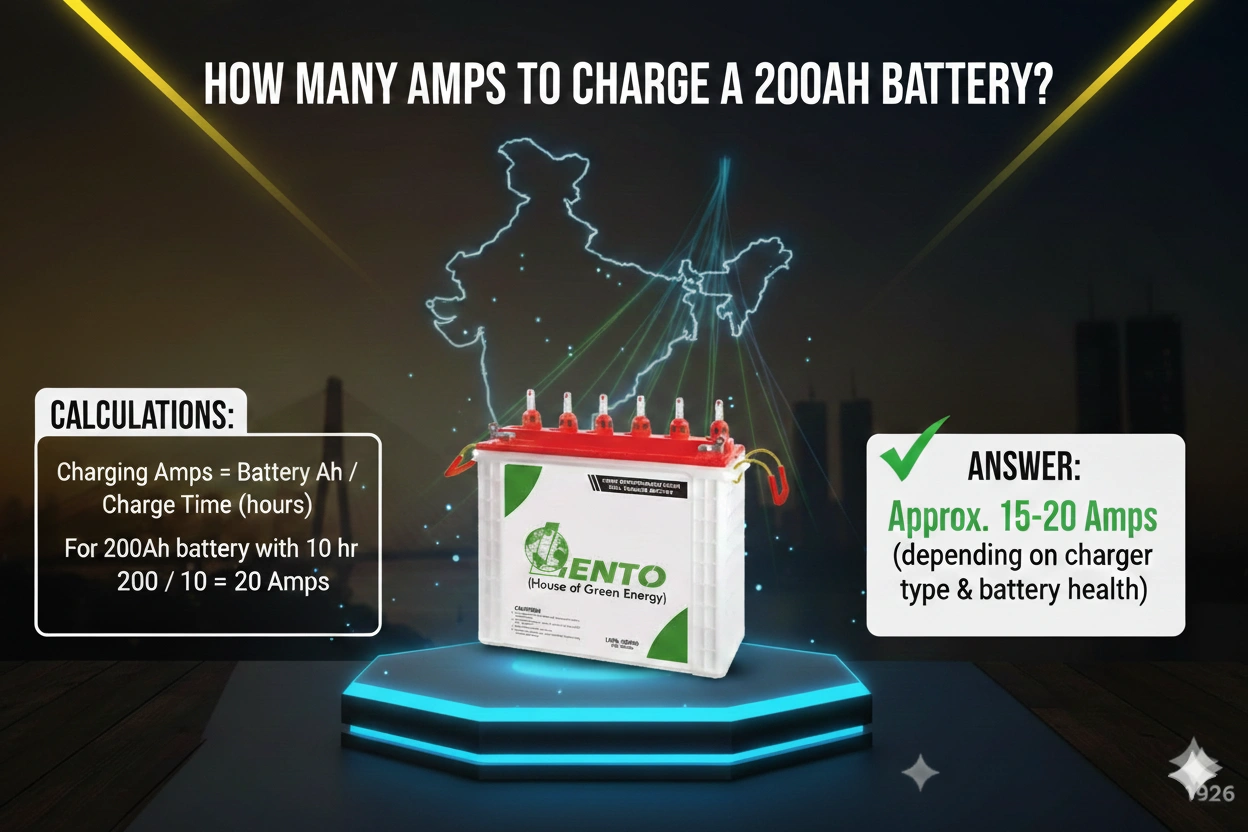
How Many Amps to Charge a 200Ah Battery
05 December 2025
Charging a 200Ah battery correctly is key to ensuring long-lasting performance and reliable backup power. Many people often ask, “How many amps should I use to charge a 200Ah battery?” or “What’s the ideal charging current to avoid damaging my battery?” In this blog, I’ll explain everything in simple terms so both home users and business owners can make informed decisions.
As a solar products manufacturer, exporter, and supplier, we provide tubular batteries, solar inverters, online UPS systems, EV chargers, and lithium-ion batteries, so this discussion will also touch on how the type of battery affects charging recommendations.
Understanding Battery Charging
Before we get to the numbers, it’s important to understand what charging a battery really means. Batteries store electrical energy chemically, and charging them involves converting electrical energy back into chemical energy.
-
Charging too slowly means the battery takes longer to reach full capacity, but it’s safer for battery life.
-
Charging too fast can overheat the battery, reduce its lifespan, or even cause damage.
So, finding the right balance is essential for your 200Ah battery, whether it’s a tubular battery or lithium-ion battery.
Recommended Charging Current for a 200Ah Battery
A good rule of thumb is to charge a battery at 10%–20% of its Ah rating. For a 200Ah battery:
-
10% charging rate: 200Ah × 0.1 = 20A
-
20% charging rate: 200Ah × 0.2 = 40A
This means the ideal charging current for a 200Ah battery lies between 20A and 40A, depending on your battery type and how quickly you want it fully charged.
Why This Range Matters
-
Low current (around 20A): Safer for battery health, reduces heating, and extends lifespan.
-
Moderate current (30–40A): Faster charging without significantly affecting battery life if monitored properly.
-
High current (>40A): Only recommended for specialized batteries designed for fast charging, usually not for standard tubular or lead-acid batteries.
Factors Affecting Charging Current
Several factors influence the right charging current for your 200Ah battery:
1. Battery Type
-
Tubular batteries: Designed for deep discharge and can handle moderate charging currents safely. Ideal for solar inverters or online UPS systems.
-
Lithium-ion batteries: More tolerant to higher currents and efficient, but require smart chargers to prevent overcharging.
2. Temperature
Battery performance is sensitive to heat. Charging at high currents in a hot environment can damage the battery, so consider ambient temperature and battery placement.
3. Charger Type
-
Smart chargers: Adjust current automatically for optimal charging and battery health.
-
Regular chargers: May need manual monitoring to avoid overcharging.
4. Battery Age and Condition
Older batteries or batteries with reduced capacity should be charged at lower currents to prevent overheating and chemical degradation.


Practical Tips for Safe Charging
To get the most out of your battery and ensure safety:
-
Always use the charger recommended by your solar inverter manufacturer or online UPS manufacturer.
-
Avoid charging in direct sunlight or extremely hot areas to prevent overheating.
-
Check battery water levels regularly if you are using tubular batteries. Low water can damage cells and reduce performance.
-
Use fuses or circuit breakers to prevent overcurrent accidents.
-
Pair your battery with a solar inverter or EV charger that matches its capacity for optimal performance.
Real-World Scenario
One of our clients installed a 200Ah tubular battery with a 3 KVA solar inverter. They used a smart charger set at 30A.
-
The battery fully charged in about 8 hours.
-
They could run multiple ceiling fans, LED lights, and a small refrigerator during power outages.
-
Regular monitoring and topping up water ensured the battery maintained efficiency for over 3 years.
This example shows that choosing the correct charging current and maintaining your battery makes a significant difference in backup reliability.
Conclusion
Knowing how many amps to charge a 200Ah battery is crucial for maintaining battery health, improving backup performance, and extending lifespan. For most tubular batteries, a charging current of 20A–40A is safe and effective. Always consider battery type, temperature, charger quality, and battery condition when deciding on the charging current.
Using quality products from a trusted solar products manufacturer, exporter, and supplier, including tubular batteries, lithium-ion batteries, solar inverters, online UPS systems, and EV chargers, ensures reliable and long-lasting performance.