
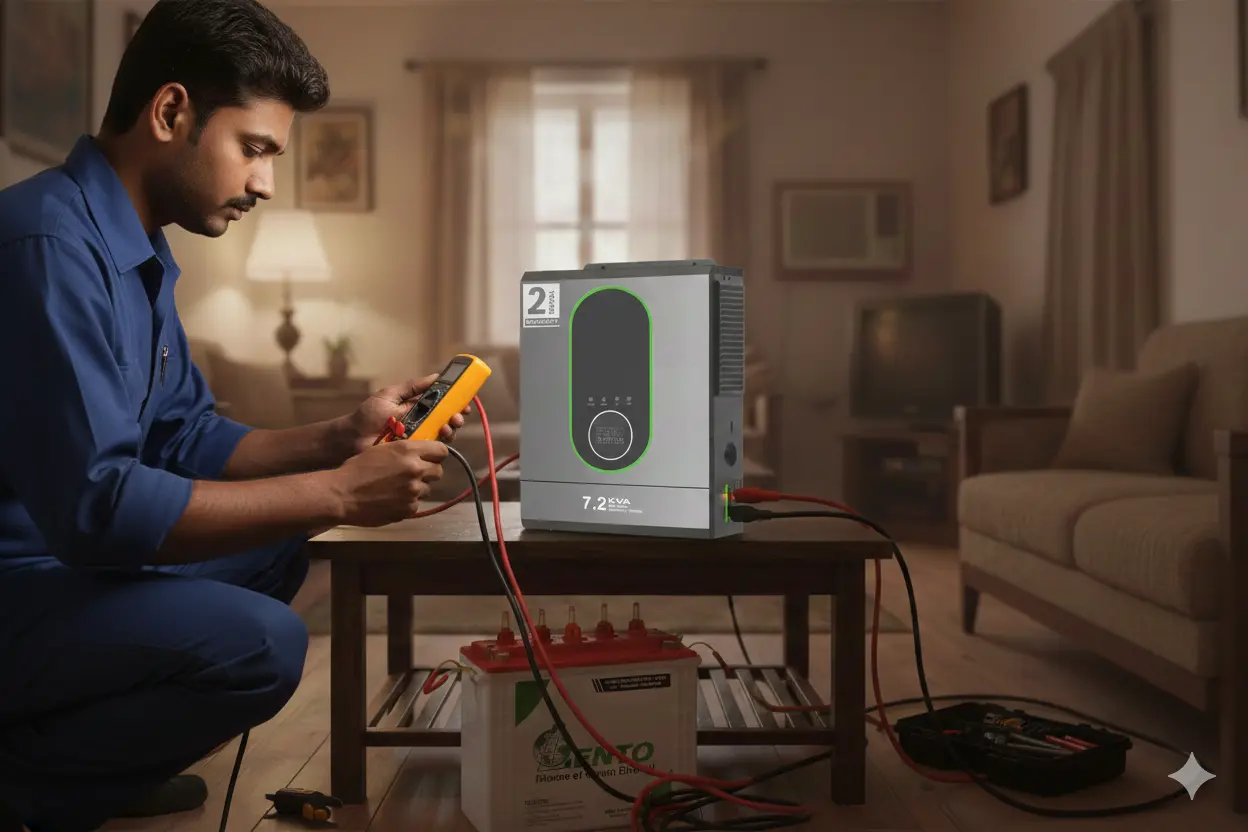
Discover Common Inverter Problems and Solutions: Symptoms, Causes & Fixes
17 October 2026
What Are the Most Common Inverter Problems and Solutions?
The most common inverter problems are no output, battery not charging, overload shutdown, short backup, delayed changeover, warning lights or error codes, and overheating. Most have simple solutions: check the MCB and fuses, clean and tighten battery terminals, reduce the load, clean the vents, and restart the unit. If the fault returns or you smell burning, book professional inverter repair.
Almost every home and shop faces inverter issues at some point, usually during a power cut. This guide helps you spot common inverter faults by symptom, understand the cause, and apply the right inverter fault solutions. It also covers inverter error codes, inverter fault finding, inverter maintenance, and when to choose inverter fault repair.
How Do You Identify Common Inverter Faults by Symptom?
Match what you see or hear to the likely fault. A beep points to overload or low battery, a red light points to a protection fault, and no output points to the MCB, fuse, or wiring.
| Symptom | Likely fault | First action |
|---|---|---|
| Inverter on, no output | Tripped MCB, blown fuse, wrong mode | Reset MCB, check mode |
| Battery will not charge | Low input voltage, loose terminals, old battery | Clean and tighten terminals |
| Beeping, then shutdown | Overload | Remove loads, reconnect one by one |
| Backup ends too soon | Ageing battery, incomplete charging | Test battery, reduce load |
| Delay or failure to switch to battery | Weak battery, relay or wiring fault | Check battery and connections |
| Red light or blinking light | Protection fault or inverter fault codes | Match the pattern with the manual |
| Heat, hum, or burning smell | Dust, poor ventilation, faulty fan or PCB | Switch off, call a technician |
What Do Inverter Error Codes and Warning Lights Mean?
Inverter error codes and warning lights show which protection has activated, such as low battery, overload, overheating, or an internal fault. The meaning differs by brand, so check your manual.
Most inverter errors appear as a red light, a blinking pattern, a display code, or a beeping alarm. Note the pattern before you switch the unit off, because it speeds up inverter troubleshooting. For a full guide, read why your inverter is showing a red light.
Problem 1: Why Is My Inverter Not Working or Giving No Output?
An inverter that is on but gives no output usually has a tripped MCB, a loose output socket, a blown internal fuse, low battery voltage, or the wrong mode selected.
This is one of the most frustrating home inverter problems. The inverter looks normal, but fans and lights stay off. The unit is working internally, but something blocks power from reaching the load.
Solutions:
- Reset the MCB.
- Inspect wires and output sockets.
- Tighten and clean battery terminals.
- Disconnect the load and restart the inverter.
- Check whether bypass, eco, or UPS mode is selected.
- If the output fuse is blown, call a technician unless you can replace fuses safely.
Problem 2: Why Is My Inverter Battery Not Charging?
A battery usually stops charging because the input voltage is too low, terminals are loose or corroded, the battery is old or sulphated, the charging fuse is blown, or the wrong charging mode is selected.
The inverter needs a minimum input voltage to start charging. In areas with fluctuating voltage, this inverter fault is common. Sulfation inside an ageing battery can also block charging.
Solutions:
- Check water levels in flooded batteries.
- Clean terminals with warm water and baking soda, then tighten them.
- Restart the inverter.
- Change the charging mode, for example from “Eco” to “UPS” or from “Normal” to “High Charging”.
- If the battery is 3–5 years old, it may be losing its ability to accept charge.
Read more in our guides on how long an inverter battery lasts and the best inverter battery for home.
Problem 3: Why Does My Inverter Beep and Shut Down?
Beeping followed by shutdown means overload protection is active. Too many appliances, high-watt devices, a faulty appliance, or a weak battery can trigger it.
A single faulty appliance, such as a fan with a bad capacitor, can make the inverter think it is overloaded.
Solutions:
- Remove all appliances.
- Reconnect them one at a time to find the faulty one.
- Keep irons, blowers, kettles, and pumps off the inverter.
- If overload continues with a light load, the internal relay or PCB may be damaged. This needs inverter repair.
If your power needs have grown, read our power inverter buying guide and learn how many 200Ah batteries a 3kVA inverter needs.
Problem 4: Why Is My Inverter Backup Time So Short?
Short backup is usually caused by an ageing battery, incomplete charging, a high connected load, or loose connections.
When backup keeps shrinking, suspect the battery first. Capacity falls as batteries age, and a battery that never reaches full charge delivers less each time.
Solutions:
- Confirm the battery charges fully after each power cut.
- Check terminals, water level, and battery voltage. A healthy 12V battery reads about 12.6–12.8V when fully charged.
- Reduce the connected load during outages.
- Replace the battery if it no longer holds charge.
See our tubular battery guide for battery basics.
Problem 5: Why Does My Inverter Not Switch to Battery Quickly?
A slow or failed changeover is usually caused by a weak battery, loose battery or output connections, or a faulty relay or PCB.
If lights flicker or go off before the inverter takes over, the battery may be too weak to support the load at that moment. Loose cables add resistance and make the problem worse.
Solutions:
- Check that the battery is charged and healthy.
- Tighten all battery and output connections.
- Reduce the load and test again.
- If the delay continues, book inverter fault repair for the relay and control board.
Problem 6: Why Is My Inverter Making Noise, Smelling, or Heating Up?
Buzzing, hissing, a burning smell, or extra heat signals internal stress, often from a dusty or failed fan, poor ventilation, loose parts, or a faulty PCB. Switch the unit off and call a technician if the smell or noise continues.
Modern inverters run cool and quiet, so a change can lead to inverter failure if ignored. Insects inside the unit can also cause trouble.
Solutions:
- Switch off the inverter and check airflow.
- Clean the vents and leave at least 6 inches of space on all sides.
- If the sound comes from inside, or you smell burning, switch it off and call a technician at once.
How Do You Do Basic Inverter Fault Finding?
Basic inverter fault finding means checking the MCB and fuses, battery terminals, battery voltage, connected load, and ventilation, in that order.
- Note any red light, blinking pattern, or error code.
- Check the MCB and output sockets.
- Inspect and tighten battery terminals.
- Measure battery voltage.
- Disconnect all loads and restart.
- Reconnect appliances one by one.
- Check the vents and the space around the unit.
If the fault returns after these steps, move to professional inverter repair.
How Can Inverter Maintenance Prevent Faults?
Regular inverter maintenance prevents most faults. Check terminals, vents, and battery water monthly, keep the unit cool, and avoid overloading.
A quick monthly checklist:
- Check the battery water level
- Tighten all terminals
- Inspect the MCB and output sockets
- Clean dust from vents
- Keep the load within the inverter rating
- Restart the inverter and test with and without load
For care routines, read our battery maintenance guide.
When Should You Call for Inverter Repair?
Call a technician if there is a burning smell, a blown internal fuse, repeated overload with a light load, an error code that returns after basic checks, or visible damage.
Do not open the inverter yourself, because internal parts carry high voltage. An authorised service centre can safely diagnose the PCB, relay, and charging section.
Should You Repair or Replace an Old Inverter?
If your inverter is 5 years old or more, or the battery is ageing, replacement is often better than repeated repairs.
When repair costs keep rising, a new unit gives better efficiency and protection. See the best inverter for home use, a space-saving wall-mounted inverter, or which type of solar inverter is right for you.
FAQs: Common Inverter Problems and Solutions
What are the most common inverter problems?
No output, battery not charging, overload shutdown, short backup, slow changeover, error codes or red light, and overheating.
Why is my inverter not working?
Usually a tripped MCB, blown fuse, low battery voltage, loose socket, or wrong mode. Check these first.
What do inverter fault codes mean?
They show which protection has activated, such as low battery, overload, or overheating. Check your manual for your model’s codes.
How can I fix inverter problems at home?
Reset the MCB, clean and tighten terminals, remove faulty loads, clean the vents, and restart. Leave internal repairs to a technician.
Why is my inverter battery backup so short?
An ageing battery, incomplete charging, or a high load. Test the battery and replace it if it no longer holds charge.
Why does my inverter keep beeping?
Beeping usually signals overload, low battery, or overheating. Reduce the load and check the battery.
Is a burning smell from an inverter dangerous?
Yes. Switch it off immediately and call a technician.
How often should I do inverter maintenance?
Check terminals, vents, and battery water monthly, and have a technician inspect the system yearly.
When should I replace my inverter instead of repairing it?
When it is 5+ years old, the battery is ageing, or repair costs keep rising.
Conclusion
Most inverter problems and solutions come down to a few basics: the MCB, battery terminals, load, ventilation, and battery health. Learn what your inverter error codes mean, keep up regular inverter maintenance, and call for inverter fault repair when you see internal faults, burning smells, or repeated failures.
Read More
- Why Is My Inverter Showing a Red Light? Common Causes and Solutions
- How Long Does an Inverter Battery Last? Guide
- Best Inverter Battery for Home in India
- Difference Between Tubular Battery and Normal Battery
- What Is a Tubular Battery? Guide
- How Many 200Ah Batteries Do You Need for a 3kVA Inverter?
- Power Inverter for Home: Complete Buying Guide
- Best Inverter for Home Use