Best Inverter to Run Air Conditioner in India: A 2026 Guide
04 December 2025
As a solar products manufacturer, exporter, and supplier, I often get asked by customers and business owners: “Which inverter is best to run my air conditioner in India?” Air conditioners are among the most power-hungry appliances in homes and offices. Choosing the right inverter ensures smooth performance, energy efficiency, and longer battery life.
In this blog, I’ll share everything you need to know—from inverter types and capacity calculations to battery considerations. As a battery, inverter, and online UPS manufacturer, I will also provide practical insights to help you make the best decision for your cooling needs.
Understanding Inverter Requirements for Air Conditioners
1. Why ACs Need Special Inverters
Air conditioners, especially split ACs, require high starting currents due to their compressors. Traditional inverters may fail to handle this surge, leading to:
-
Frequent tripping
-
Reduced backup time
-
Potential damage to both inverter and AC
A high-quality inverter designed for heavy loads ensures:
-
Smooth start without voltage dips
-
Longer backup during power cuts
-
Compatibility with batteries for uninterrupted operation
2. Types of Inverters Suitable for ACs
There are three main types of inverters you’ll encounter:
-
Pure Sine Wave Inverters: Ideal for air conditioners and sensitive electronics; they provide stable, clean power.
-
Modified Sine Wave Inverters: Cheaper but may reduce AC efficiency and cause noise; not recommended for heavy loads.
-
Hybrid Solar Inverters: Can charge batteries via solar panels while powering appliances, reducing grid dependence.
As a solar products manufacturer and exporter, I recommend pure sine wave inverters for ACs because they protect your equipment and ensure optimal performance.
Calculating the Right Inverter Capacity
1. Understanding AC Power Ratings
Air conditioners are rated in tons and watts:
-
1 ton = approximately 1.2 kW
-
A 1.5-ton AC = ~1800W running power
-
Start-up surge can be 2–3 times the running power
2. Recommended Inverter Capacity
To select the best inverter, consider:
-
Running load: Continuous power the AC consumes (~1800W for 1.5-ton)
-
Surge load: Starting current (2× running load for safe margin)
For a 1.5-ton AC, a 3 kVA inverter is ideal, while a 2-ton AC may need a 4–5 kVA inverter.
3. Battery Considerations
Battery size affects backup time. For example:
-
Tubular batteries handle deep discharges and high loads better
-
Lithium-ion batteries are more efficient and longer-lasting but costlier
-
Ensure battery voltage matches inverter input (12V, 24V, or 48V)
As a battery, inverter, and online UPS manufacturer, I recommend using high-quality batteries from trusted suppliers to get maximum backup for your AC.
Lento Hybrid Solar Inverter is the Best Choice to Run Your Air Conditioner
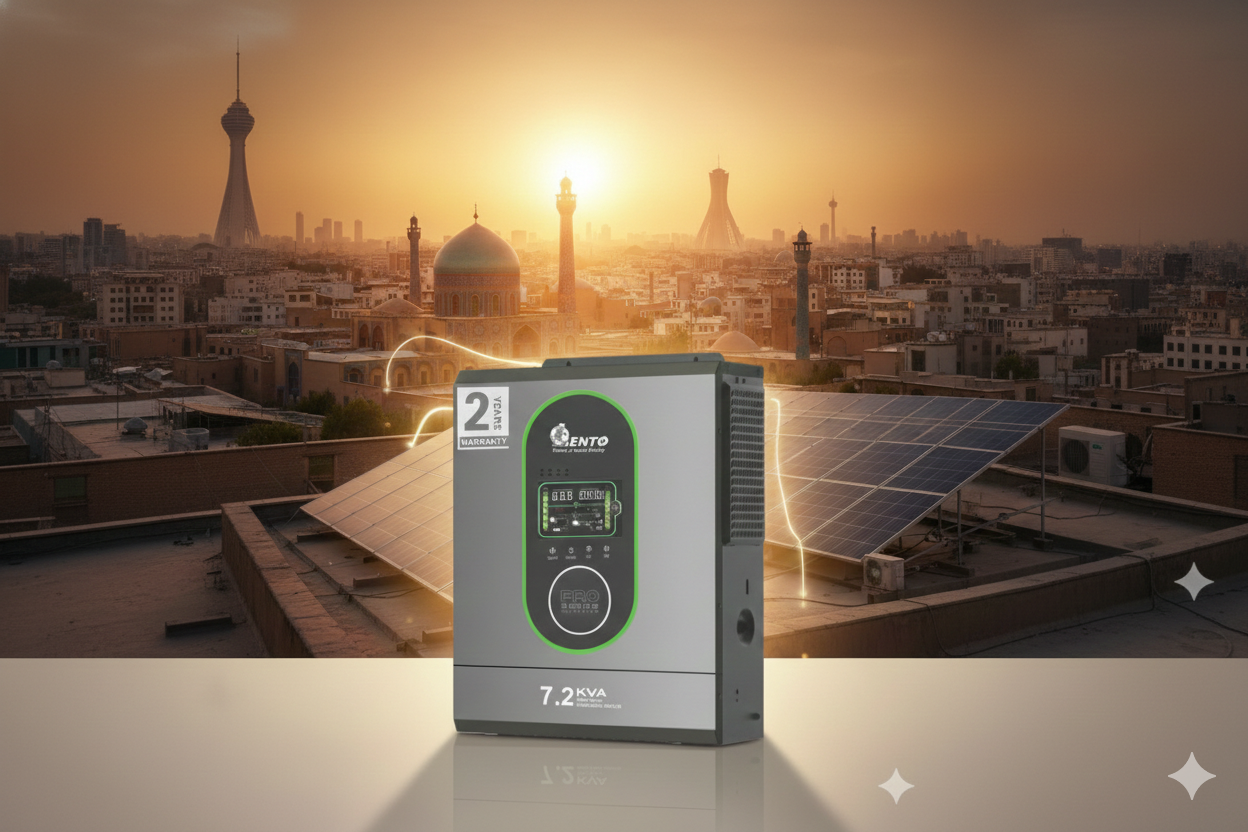
When it comes to running high-power appliances like air conditioners, not all inverters are created equal. As a solar products manufacturer and exporter, I’ve seen many customers struggle with inverters that either can’t handle AC surges or drain batteries too quickly. That’s why I always recommend the Lento Hybrid Solar Inverter from our Eco-Sun Series.
1. Wide Range for Every Need
Whether you have a small home AC or multiple industrial units, Lento provides variants to match your exact load requirement:
-
700 VA / 12 VDC
-
900 VA / 12 VDC
-
1100 VA / 12 VDC
-
1450 KVA / 24 VDC
-
1600 KVA / 24 VDC
-
2100 KVA / 24 VDC
-
2.5 KVA / 24 VDC
This extensive range ensures that whether you need to run a 1.5-ton AC in your home or a 5-ton AC in a commercial setting, there’s a Lento Hybrid Solar Inverter ready to provide uninterrupted, reliable power.
2. Pure Sine Wave Output for Smooth AC Operation
Air conditioners require a stable, clean power supply, especially during startup when the compressor draws a higher surge current. The DSP-based design of the Lento Hybrid Solar Inverter ensures:
-
Stable pure sine wave output
-
Smooth start for AC compressors
-
Protection against tripping and voltage fluctuations
This makes it perfect for both domestic and industrial AC units.
3. Intelligent Energy Management
Our Lento Hybrid Solar Inverter doesn’t just supply power—it intelligently manages it:
-
Automatically switches between solar and grid power
-
Optimizes battery usage for longer backup
-
Reduces electricity costs by using solar during peak sun hours
This means your AC keeps running efficiently without overloading your system or draining your batteries.
4. Trusted by Businesses and Homes
With robust construction and advanced DSP technology, the Lento Hybrid Solar Inverter is trusted across industries. From residential AC setups to commercial office spaces, our inverters ensure uninterrupted cooling even in challenging conditions.
Pro Tip: For maximum efficiency, pair your Lento Hybrid Solar Inverter with tubular batteries or lithium-ion batteries to achieve longer backup times, especially during hot summer months when AC usage is at its peak.
Factors to Consider Before Buying an AC Inverter
1. Efficiency and Backup Time
-
Higher capacity inverters provide longer backup
-
Check inverter efficiency (90–95% ideal)
-
Combine inverter rating with battery AH to estimate runtime
2. Solar Integration
If you plan to use solar power:
-
Hybrid inverters can charge batteries and run AC simultaneously
-
Reduces electricity bills and dependency on grid power
-
Compatible solar panels can further enhance performance
3. Brand and Reliability
-
Choose inverters from a reliable solar products manufacturer and exporter
-
High-quality inverters protect both AC and battery
-
Look for after-sales support and warranty
4. Installation and Maintenance
-
Professional installation ensures inverter safety and battery longevity
-
Regular maintenance of batteries and inverter prevents voltage drops and tripping
Practical Example
Let’s consider a home setup:
-
1.5-ton split AC
-
3 kVA pure sine wave inverter
-
24V, 200AH tubular battery
Calculations:
-
AC running power: 1800W
-
Surge power: 3600W
-
Backup time with 200AH battery at 50% DoD:
Backup Time=24V×200AH×0.51\ 800W≈1.3 hours
By adding a second battery or increasing battery AH, backup can be extended to 2–3 hours. For businesses with multiple AC units, a 5 kVA inverter with 48V, 400AH batteries provides stable power for longer durations.
Conclusion
If you want a reliable, efficient, and high-performing inverter for your air conditioner, the Lento Hybrid Solar Inverter is the best choice in India. Its wide range, smart energy management, and DSP-based design make it ideal for any home or business looking for uninterrupted cooling.