
150Ah to Watts
05 December 2025
Whether you are buying a battery for your home inverter, comparing options from an online UPS manufacturer, or selecting storage for a commercial UPS from an online UPS supplier or online UPS trader, knowing the watt capacity of a 150Ah battery is essential. It helps you calculate backup time, load capacity, and system sizing with complete confidence.
In this blog, I’m going to simplify the entire concept of converting 150Ah to watts. I’ll walk you through formulas, examples, practical scenarios, and pro tips that I’ve gathered from years of working around solar systems, inverter batteries, and online UPS solutions.
Let’s begin.
What Does 150Ah Really Mean?
Before we convert 150Ah to watts, let me break down the concept in simple terms.
A 150Ah battery means:
👉 The battery can supply 150 amps for 1 hour,
or
👉 15 amps for 10 hours,
or
👉 7.5 amps for 20 hours,
depending on the load connected.
So Ah (ampere-hour) is basically a measure of the battery’s storage capacity. It tells you how much current the battery can deliver over time.
For most home and office inverter systems, 150Ah is one of the most commonly used capacities, especially when paired with 12V and 24V inverter systems. Even business owners who buy backup storage equipment from an online UPS manufacturer or online UPS supplier often choose 150Ah batteries because they strike a perfect balance between backup duration and cost.
How to Convert 150Ah to Watts
This is where many people get confused, but trust me—it's very simple.
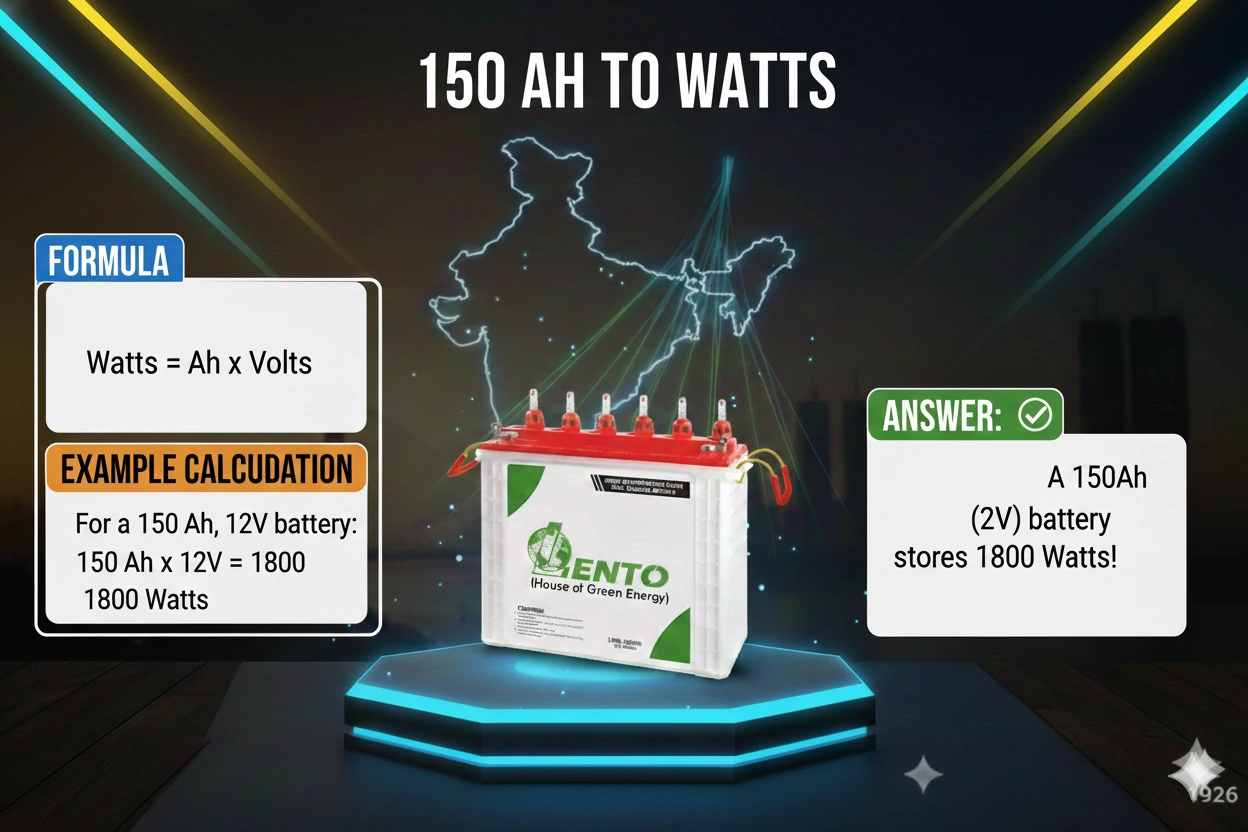
Formula: Watts = Ah × Voltage
In our case:
Watts = 150Ah × Battery Voltage
But here's the catch:
Batteries come in different voltages—12V, 24V, 48V, and even 96V for online UPS systems.
So the watt capacity of a 150Ah battery depends entirely on its voltage.
Let me calculate each one for you.
150Ah Battery in 12V: How Many Watts?
Most home inverters use a 12V, 150Ah battery.
Watts = 150 × 12
Watts = 1800 watt-hours
This means:
A 150Ah 12V battery stores 1.8 kWh of energy.
But that’s the ideal rating.
In real conditions, you get slightly less due to:
-
Losses
-
Temperature
-
Battery efficiency
-
Inverter conversion losses
Actual usable energy is around 1.4–1.5 kWh.
150Ah in 24V Systems
Some homes and small businesses use 24V inverters. This is common when buying systems from an online UPS trader or online UPS manufacturer, as higher voltage setups offer better efficiency.
Watts = 150 × 24
Watts = 3600 watt-hours
This equals 3.6 kWh of stored energy.
Usable energy = 2.8–3 kWh
150Ah in 48V Systems
Most office UPS systems—especially those supplied by an online UPS supplier—use 48V battery banks.
Watts = 150 × 48
Watts = 7200 watt-hours
This means 7.2 kWh of available energy (ideal).
Actual usable: 5.5–6 kWh
This level of energy storage is enough for:
-
Server rooms
-
Point-of-sale systems
-
Office computers
-
Security systems
-
Medical labs
48V systems are highly efficient and stable, which is why online UPS manufacturers prefer them.
Battery Voltage Matters: Why?
The watt output increases proportionally with voltage. So the same 150Ah gives drastically different watt energy at different voltages.
This is why commercial UPS designs use higher voltage—because:
-
Higher voltage = lower current
-
Lower current = lower heat
-
Lower heat = longer battery life
-
System becomes more efficient
This is also why business owners sourcing from an online UPS supplier prefer 48V and 96V setups.
Understanding Ideal vs Usable Watts
One thing I always tell my clients:
You never get 100% of the calculated wattage in real life.
Why?
Because of:
Battery Efficiency Loss
Lead-acid batteries are 80–85% efficient.
Lithium batteries are 92–97% efficient.
Inverter Conversion Loss
Most inverters have 85–95% efficiency.
Depth of Discharge Limit
Lead-acid cannot be discharged fully.
Safe DoD = 50–70%.
This means:
If you calculated 1800W, your real usable output might be 1100–1400W depending on losses.
How Long Can a 150Ah Battery Run Different Appliances?
This is one of the most useful parts of the blog, especially for homeowners and businesses using inverter systems.
Let’s assume a 12V 150Ah battery (most common).
Usable watt-hours ≈ 1400W
1. Running Fans & Lights
-
2 fans (70W each) = 140W
-
4 LEDs (40W) = 40W
Total = 180W
Backup = 1400 ÷ 180
Backup ≈ 7.7 hours
2. Running a TV + Lights
-
LED TV = 120W
-
4 LEDs = 40W
Total = 160W
Backup = 1400 ÷ 160
Backup ≈ 8.7 hours
3. Running a Refrigerator
Refrigerator approx = 200W running load
Backup = 1400 ÷ 200
Backup = 7 hours
4. Running a Computer + Router
PC = 150W
Router = 12W
Total = 162W
Backup = 1400 ÷ 162
Backup ≈ 8.6 hours
5. Running Office Load (24V or 48V systems)
Businesses often ask me:
“How many PCs can a 150Ah battery bank support?”
Here’s a quick idea:
At 48V (usable ~6000W)
Each PC = 150W
6000 ÷ 150 = 40 PCs (theoretically)
Usually, offices run 12–20 PCs with a 150Ah 48V battery bank supplied by an online UPS manufacturer.
150Ah Battery for Solar Systems
In solar installations, the watt-hour capacity directly affects:
-
Solar panel sizing
-
Charge controller rating
-
Inverter selection
-
Backup duration at night
A 150Ah battery at 12V gives 1.5 kWh usable, so if you need 6 hours of backup, you size loads accordingly.
Many solar EPCs and online UPS traders also bundle 150Ah batteries with:
-
1kW solar systems
-
2kW solar systems
-
Hybrid inverters
because they are reliable and easy to maintain.
Choosing the Right Inverter for a 150Ah Battery
A well-matched inverter ensures:
-
Smooth charging
-
Maximum backup
-
Longer battery life
Here’s what I personally recommend:
For Home Use
-
800VA to 1500VA inverter
-
12V system
-
Tubular battery (150Ah)
For Small Offices
-
24V inverter
-
1500VA–3000VA
-
SMF or tubular batteries
For Commercial UPS Systems
-
48V UPS
-
Supplied by an online UPS manufacturer or online UPS supplier
-
150Ah SMF or lithium batteries
150Ah Battery: Lead-Acid vs Lithium-ion
This is where many buyers make the wrong decision because they compare Ah directly without understanding chemistry.
Lead-Acid 150Ah
-
Cheaper
-
Needs maintenance
-
50% usable capacity
-
Heavy
-
3–4 years life
Lithium 150Ah
-
Higher price
-
Maintenance-free
-
90–95% usable
-
Lightweight
-
8–12 years life
-
Faster charging
If you're buying from an online UPS trader for commercial use, lithium options are worth the investment.
Practical Uses of a 150Ah Battery
A 150Ah battery is widely used in:
-
Homes
-
Shops
-
Small offices
-
Clinics
-
ATMs
-
Security systems
-
Server rooms
-
Retail counters
-
Solar hybrid setups
-
School computer labs
These installations often use power backup equipment purchased from an online UPS manufacturer or online UPS supplier, especially when long, stable backup is needed.
Common Mistakes People Make When Calculating Watts
Even experienced users sometimes miscalculate watt capacity. Here are the mistakes I see most often:
-
Assuming 150Ah = 150 × 12 = 1800W usable (not true)
-
Ignoring inverter losses
-
Ignoring safe depth of discharge
-
Running heavy appliances on inverter
-
Using cheap batteries from unreliable sellers
Accurate calculations always include real-life efficiency factors.
Why Understanding Watts Is Important for Businesses
If you run a shop, office, or small manufacturing unit and buy power backup from an online UPS manufacturer or online UPS supplier, knowing watt capacity helps you:
-
Avoid overload
-
Plan backup time
-
Select correct inverter
-
Size battery banks
-
Estimate cost of ownership
-
Improve uptime and efficiency
Conclusion
Converting 150Ah to watts is one of the most important steps when designing an inverter or UPS system. Whether you're a homeowner planning peaceful backup or a business owner sourcing solutions from an online UPS manufacturer, online UPS supplier, or online UPS trader, watt-hours tell you exactly how much power your battery can store and how long your appliances will run.
Once you understand voltage, efficiency, and real-world factors, sizing your backup system becomes simple, accurate, and cost-effective.
A perfectly sized battery system doesn’t just give backup—it gives peace of mind.