
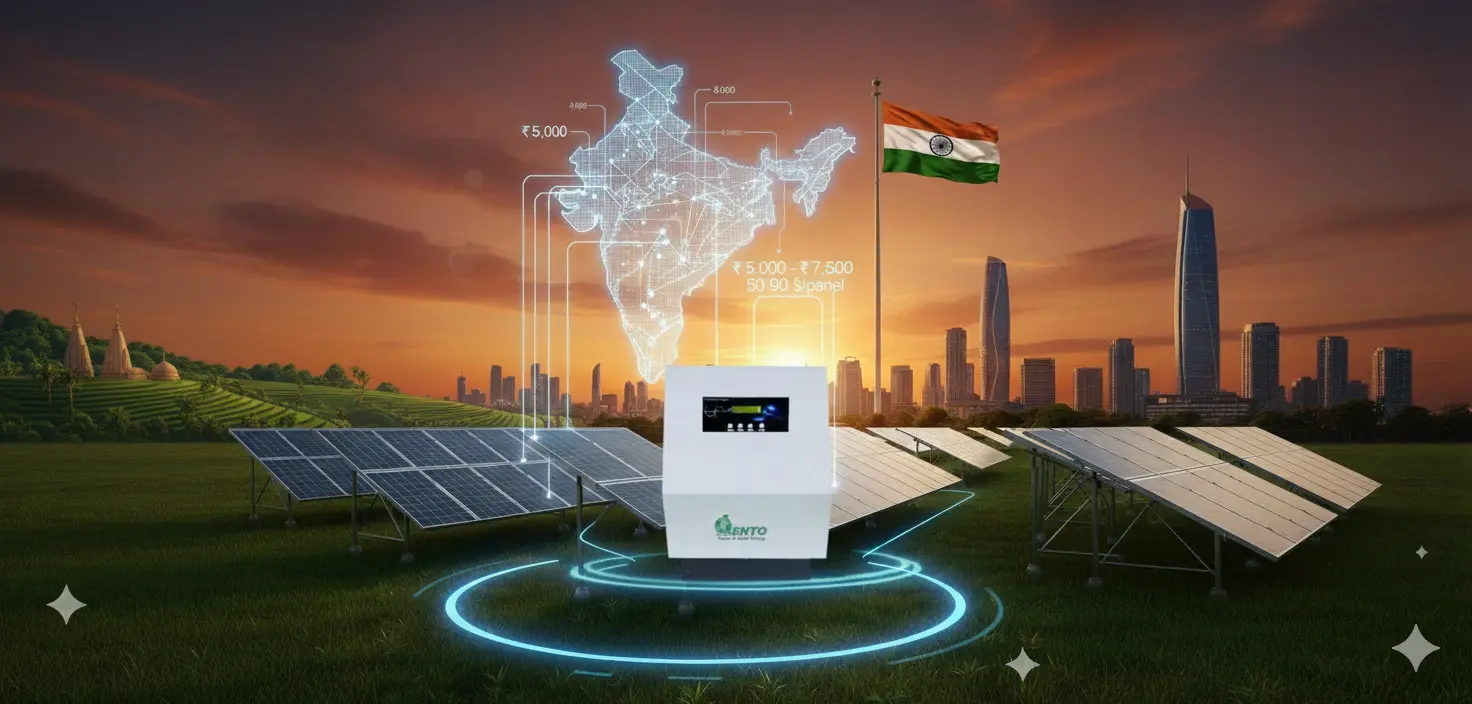
What Is the Cost of 165 Watt Solar Panels in India?
06 December 2025
As someone who has been closely involved in the solar and power backup industry for years, I know how confusing it can feel when you’re trying to choose the right solar panel for your home or business. Among the many options available, the 165-watt solar panel stands out as a popular and practical choice. It offers good efficiency, affordability, and flexibility—making it ideal for small home systems, office setups, shops, farm use, and even small industrial needs.
In this blog, I’ll walk you through everything you need to know about the cost of 165-watt solar panels in India, along with the factors influencing their pricing, installation considerations, compatibility, and who should ideally invest in them. I’ll also share insights from the perspective of Lento, a leading brand known for dependable power solutions, including our presence as an online UPS manufacturer, online UPS supplier, and online UPS trader.
Understanding the Demand for 165 Watt Solar Panels in India
Over the last few years, I’ve noticed a sharp rise in interest in small to mid-sized solar panels in the Indian market. Homeowners, small shop owners, and micro-businesses often prefer 165W panels because they can be installed even in limited roof space while still generating respectable power output.
These panels offer a good blend of:
-
Affordability
-
Suitable wattage for day-to-day appliances
-
Easy installation
-
Broad compatibility with inverters and batteries
-
Ideal for both off-grid and hybrid systems
Their utility increases further when paired with high-efficiency inverters and reliable battery setups—areas where Lento has been serving thousands of customers across India.
How Much Does a 165 Watt Solar Panel Cost in India?
As of 2026 market standards, a 165-watt solar panel in India typically costs between ₹4,000 and ₹8,000 per panel.
This price variation depends on factors like:
-
Type of solar panel (Polycrystalline or Monocrystalline)
-
Brand reliability
-
Warranty terms
-
Efficiency percentage
-
Market demand and supply
-
Installation location
-
Whether you buy online or offline
Most end customers prefer panels between ₹25–₹40 per watt, and 165W panels often fall right in the middle of this bracket.
If you’re planning to purchase in bulk—for a commercial project, dealership, or retail sale—the pricing can be even more competitive, making it a great opportunity for business owners.
Types of 165-Watt Solar Panels Available in India
Polycrystalline Solar Panels
These are the most common and affordable type of 165W panels. They perform well even in high-temperature conditions, which suits most parts of India.
Monocrystalline Solar Panels
Although a bit costlier, monocrystalline panels offer higher efficiency and better performance in low-light conditions. If your installation area is small, these panels might provide a better yield.
The price difference between the two types usually ranges from ₹500 to ₹1,500 per panel.
Why Choose a 165 Watt Solar Panel?
From my experience working with customers across India, I see this panel size most suitable for:
-
Small households needing backup for mobile charging, LED lights, Wi-Fi routers, fans
-
Small shops requiring backup for POS machines, computers, and lighting
-
Farmers looking to operate FAs, sensors, or low-watt pumps
-
RVs and portable setups
-
Battery charging stations
-
Small educational centers and clinics
The utility multiplies when combined with a good inverter-battery system. As Lento is widely trusted as an online UPS manufacturer, online UPS supplier, and online UPS trader, we often see customers using these solar panels along with advanced UPS systems for improved reliability.
What Affects the Price of 165 Watt Solar Panels?
To help you make an informed decision, let me break down the major price influencers:
Panel Type and Efficiency
Higher efficiency panels always cost more. Monocrystalline panels are costlier but deliver better performance.
Brand Value
Top manufacturers with certified quality, long warranties, and proven durability naturally charge higher.
Market Fluctuations
Solar raw materials—including silicon—experience price shifts based on global trends.
Warranty Period
Premium brands offer warranties of 10–25 years, which raises the initial cost but assures long-term value.
Certification and Build Quality
Panels with MNRE approval or IEC certification tend to be slightly more expensive but more reliable.
Distribution Channel
Local dealers offer competitive pricing, while online marketplaces may include additional delivery costs.
Realistic Power Output of a 165W Solar Panel in India
A 165W solar panel typically generates 650–850 Wh per day, depending on the region and sunlight exposure.
Average daily generation varies:
-
In high-sunlight states: Rajasthan, Gujarat, Telangana → 800+ Wh/day
-
In moderate-sunlight states: Maharashtra, MP, UP → 700–780 Wh/day
-
In cloudy/rainy climates: Kerala, Bengal, Northeast → 600–700 Wh/day
This production level is suitable for lower consumption appliances but can be expanded by connecting multiple panels in series or parallel.
How Many 165W Panels Do You Need?
Here’s a straightforward explanation I give to customers:
-
For small home backup (basic appliances) → 2–4 panels
-
For shops or office loads → 4–6 panels
-
For battery charging setups → depends on capacity
-
For hybrid systems → customized based on load assessment
Whenever a customer connects with us at Lento, we run a detailed load analysis before suggesting the right number of panels.
165 Watt Solar Panel + Inverter + Battery: The Perfect Combination
A solar panel alone doesn’t complete the system. The real performance comes from integrating three core components:
-
Solar Panel
-
Inverter/UPS
-
Battery
This is where Lento stands strong. As an industry-recognized online UPS manufacturer, online UPS supplier, and online UPS trader, we build systems that complement solar power seamlessly.
Why the Right Inverter Matters
A solar inverter optimizes efficiency, prevents overload, and ensures smooth switching between solar and grid.
Why the Right Battery Matters
A high-cycle battery retains charge longer and delivers stable backup without voltage drops.
Together, they ensure your 165W panels perform at their highest capacity.
Installation & Maintenance Costs to Consider
Most people focus only on panel cost but overlook the additional expenses. Here’s what normally adds to the budget:
-
Solar mounting structure
-
Wiring and connectors
-
Charge controller (if using non-solar inverter)
-
Installation labor charges
-
Transport charges
-
Optional accessories like DCDB/ACDB
On average, installation adds 8–15% additional cost to the project.
Maintenance, fortunately, is minimal—usually limited to cleaning and occasional performance checks.
Is a 165 Watt Solar Panel Worth It? My Expert Opinion
Absolutely yes—especially for:
-
First-time solar users
-
Lower consumption needs
-
Compact rooftops
-
Cost-conscious buyers
-
Backup power requirements
-
Small business owners planning phased solar expansion
The affordability and flexibility of a 165W panel make it the perfect entry-level solar solution in India.
And when paired with Lento’s high-quality UPS/inverter systems, the performance becomes significantly more reliable and long-lasting.
Lento India – Global B2B Solar Exporter
Lento India proudly exports solar and power solutions to 24 countries including Mexico, Chile, Peru, Ecuador, Dominican Republic, Afghanistan, Nigeria, Iraq, Uganda, Yemen, Syria, Iran, Oman, Morocco, Egypt, and Kuwait.
We supply solar panels, tubular batteries, SMF batteries, inverters, and Online UPS systems to global distributors, OEMs, and large-scale installers.
Lento India – Powering industries, homes, and communities across continents with trust and technology.
Conclusion
Understanding the cost of 165-watt solar panels in India is the first step toward building your own solar power system. With prices ranging from ₹4,000 to ₹8,000, these panels offer an excellent balance of affordability, efficiency, and versatility. Whether you’re a homeowner, shop owner, or business operator, 165W panels provide a practical and scalable way to begin your solar journey.
At Lento, we’ve seen thousands of customers successfully build reliable solar setups using these panels combined with our inverter and UPS solutions. If you’re planning your solar system, want dealership opportunities, or need bulk supply, this is the right time to step in.
FAQ
What is the price of a 165W solar panel in India?
The cost usually ranges between ₹4,000 and ₹8,000 depending on brand, type, and warranty.
Are 165W solar panels good for home use?
Yes, they are perfect for small loads like lights, fans, routers, laptops, and mobile charging.
How many units can a 165W solar panel generate in one day?
It generates around 0.65–0.85 units per day, depending on sunlight availability.
Can I use a 165W panel with any inverter?
Yes, but solar-specific inverters or UPS systems deliver much better results.
Do 165W panels require maintenance?
Only basic cleaning and occasional wiring checks are required.
Is it suitable for shop or office use?
Yes, especially for basic loads like computers, lights, and point-of-sale devices.
Can a 200 watt solar panel run a 12 volt refrigerator?
Yes, a 200-watt solar panel can run an energy-efficient 12V fridge, provided there is adequate sunlight and battery storage.
Can I run a 1.5 ton AC on solar?
In summary, it is efficient and sustainable to power a 1.5-ton air conditioner using solar energy