What Is a Lithium Battery Inverter?
19 May 2026
What Is a Lithium Battery Inverter? Start Here.
If you have been comparing a lithium battery inverter against a conventional power inverter for home, evaluating a solar inverter for your rooftop, or trying to decide between a standard inverter for home backup and a more advanced hybrid solar inverter — you have likely encountered the term "lithium battery inverter" without a clear, plain-English explanation of what it actually is. Simply put: a lithium battery inverter is a power backup system that uses a lithium ion battery for inverter storage instead of a conventional lead-acid battery, converting stored DC energy into AC electricity to power your home appliances during a power cut or from solar energy. It is increasingly recognised as the best inverter with battery for home use in India — and this 2026 guide by Lento Industries Private Limited explains exactly what it is, how it differs from conventional systems, and which type is right for your home or business.
The Precise Definition: What Is a Lithium Battery Inverter?
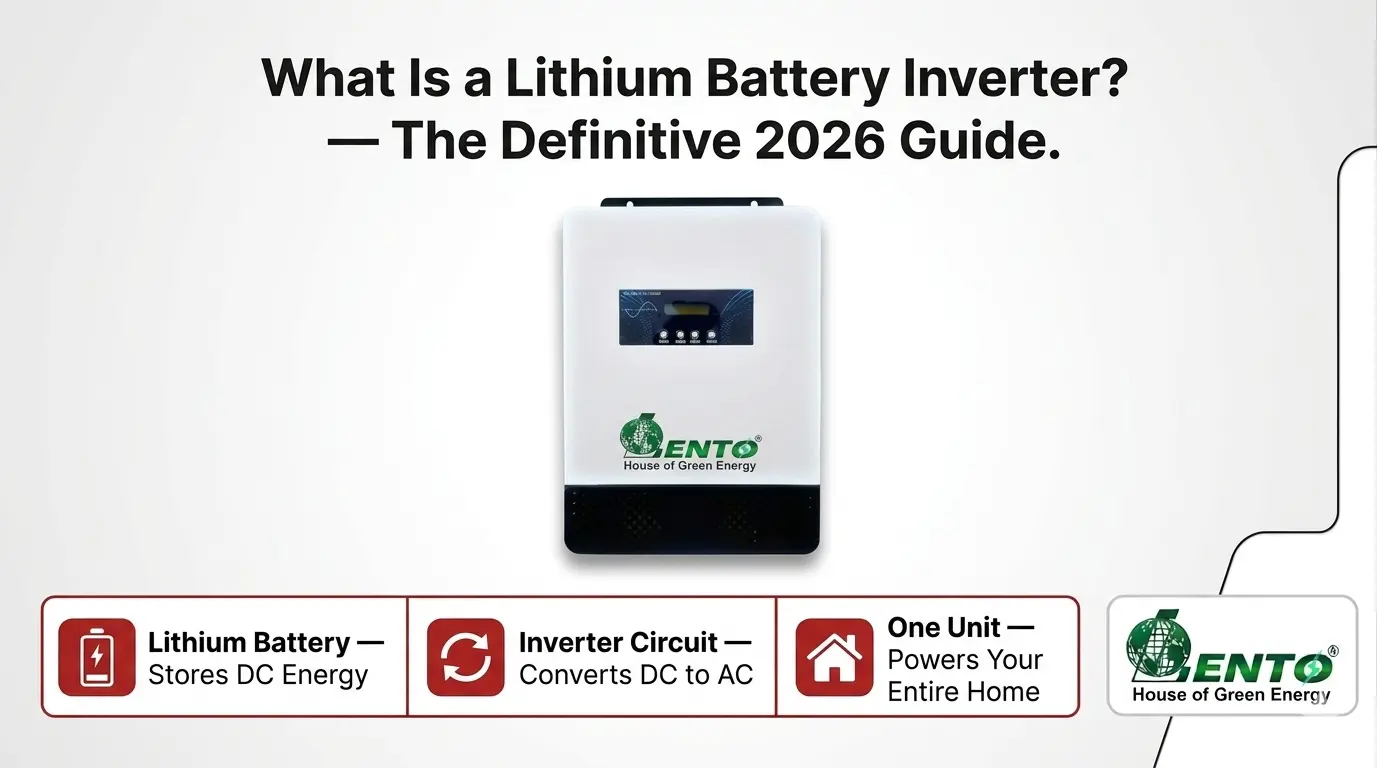
A lithium battery inverter is a power electronics system comprising two integrated components:
1. A lithium-ion battery — specifically LiFePO4 (Lithium Iron Phosphate) for home and commercial applications — that stores electrical energy in chemical form and releases it as direct current (DC) on demand.
2. An inverter circuit — power electronics that convert the battery's DC output into alternating current (AC) at the correct voltage and frequency (230V, 50Hz in India) to power standard household appliances.
In a lithium battery and inverter system of the modern inbuilt type, these two components are housed in a single factory-integrated unit — eliminating the need for a separate battery, external wiring, and independent warranty management.
The defining characteristic that separates a lithium battery inverter from a conventional inverter is the battery chemistry. Lead-acid batteries — the traditional choice — are heavy, require regular maintenance, and deliver only 40–50% of their rated capacity. A lithium inverter battery is sealed, maintenance-free, delivers 80–90% of rated capacity, charges in 3–4 hours, and lasts 8–12 years with daily cycling.
Lithium Battery Inverter vs Conventional Inverter: The Core Differences
|
Feature |
Lithium Battery Inverter |
Conventional Lead-Acid Inverter |
|
Battery chemistry |
LiFePO4 / Li-ion |
Lead-acid (flooded or sealed) |
|
Usable capacity |
80–90% of rated Ah |
40–50% of rated Ah |
|
Weight |
60% lighter |
Heavy — 45–55 kg for 150Ah |
|
Charge time |
3–4 hours |
8–10 hours |
|
Maintenance |
Zero — fully sealed |
Annual water top-up, terminal cleaning |
|
Cycle life |
3,000–5,000 cycles |
500–800 cycles |
|
Lifespan |
8–12 years |
3–5 years |
|
Solar compatibility |
Native — PWM and MPPT ready |
Requires external controller |
|
Space required |
Single compact unit |
Two separate components |
|
Pure sine wave |
Standard in quality units |
Varies by model |
Types of Lithium Battery Inverters: Which One Do You Need?
There are three distinct types of lithium ion inverter systems — each serving a different home and commercial power profile:
Type 1: Sine Wave Lithium Battery Inverter
A grid-powered backup system with a lithium battery replacing the traditional lead-acid unit. Charges from the electricity grid and switches to battery power instantly during outages. Delivers pure sine wave AC output — safe for all appliances.
Best for: Homes that experience regular power cuts and want zero-maintenance backup without rooftop solar.
Type 2: PWM Hybrid Lithium Battery Inverter
Adds a PWM (Pulse Width Modulation) solar charge controller to the lithium inverter — enabling rooftop solar panels to charge the battery directly during daylight hours. Reduces electricity bills by 25–40% for a 1–3 panel installation.
Best for: Homes beginning solar adoption on a budget, with small panel arrays.
Type 3: MPPT Hybrid Lithium Battery Inverter
The most advanced lithium ion inverter type — uses MPPT (Maximum Power Point Tracking) technology to extract up to 30% more energy from solar panels than PWM. The definitive choice for homes with 4+ panels seeking maximum solar yield and lowest long-term electricity costs.
Best for: Solar-committed homes, large residences, and commercial properties seeking the highest return on solar investment.
Lento Industries: India's Complete Lithium Battery Inverter Range
Lento Industries manufactures all three types as fully inbuilt systems — battery, BMS, and inverter factory-matched and tested as one integrated unit.
Series 1 — Sine Wave Inverter with Inbuilt Lithium Battery
The most universally compatible li ion inverter for Indian homes. Pure sine wave output protects every appliance — from refrigerator compressors to medical nebulisers to smart televisions.
|
Model |
Battery Voltage |
Rated Capacity |
Compatible Battery |
Applications |
|
Li-ion 1100VA/12V |
12.8V |
1100 VA |
Lithium Battery (100AH) |
Household and commercial |
|
Li-ion 2100VA/24V |
25.6V |
2100 VA |
Lithium Battery (100AH) |
Commercial spaces, hybrid solar |
|
Li-ion 2100VA/24V |
25.6V |
2500 VA |
Lithium Battery (100AH) |
Commercial and household |
Price range: ₹18,000 – ₹38,000 What it is in practice: A single compact unit that replaces a conventional inverter + lead-acid battery setup — delivering better backup, faster recharge, and zero maintenance from day one.
Series 2 — Hybrid Solar Inverter with Inbuilt Lithium Battery (Off-Grid PWM)
A lithium battery with inverter and solar charging in one factory-integrated unit. No separate solar charge controller required.
|
Model |
Battery Voltage |
Rated Capacity |
Compatible Battery |
Applications |
|
Li-ion 1100VA/12.8V |
12.8VDC |
1100 VA |
Lithium Battery (100AH) |
Household |
|
Li-ion 2100VA/25.6V |
25.6VDC |
2100 VA |
Lithium Battery (100AH) |
Household |
|
Li-ion 2100VA/25.6V |
25.6VDC |
2500 VA |
Lithium Battery (100AH) |
Household |
Price range: ₹22,000 – ₹40,000 What it is in practice: A complete solar backup system for Indian homes — the inverter, lithium battery, and PWM solar controller all factory-integrated into one plug-and-play unit.
Series 3 — Hybrid Solar Inverter with Inbuilt Lithium Battery (Off-Grid MPPT)
Lento's premium inverter with lithium battery — maximum solar efficiency meets maximum battery protection in a single engineered system.
|
Model |
Battery Voltage |
Rated Capacity |
Compatible Battery |
Applications |
|
Li-ion 1100VA/12V |
12.8V |
1100 VA |
Lithium Battery |
Household |
|
Li-ion 2100VA/24V |
25.6V |
2100 VA |
Lithium Battery |
Household and commercial |
|
Li-ion 2500VA/24V |
25.6V |
2500 VA |
Lithium Battery |
Household and commercial |
Price range: ₹28,000 – ₹48,000 What it is in practice: India's most complete off-grid solar and backup system for homes and commercial spaces — MPPT solar charging, LiFePO4 battery storage, and pure sine wave output in a single maintenance-free unit.
What Makes a Lithium Battery Inverter "Inbuilt"?
The term inbuilt lithium battery inverter — used across Lento's range — refers specifically to a system where:
- The LiFePO4 lithium battery pack is housed inside the same enclosure as the inverter electronics
- The BMS is factory-calibrated for the specific inverter's charge profile — not a generic external unit
- The entire system is tested and warranted as one product — not two separate components with separate warranties
- Installation is plug-and-play — no external battery wiring, no compatibility verification, no professional configuration required
This is the key distinction between Lento's systems and brands that sell the inverter and lithium battery separately — leaving buyers to manage compatibility, wiring, and dual warranty claims independently.
Lithium Battery Inverter Price Reference — India 2026
|
System Type |
Capacity |
Lithium Battery |
Total System Price (INR) |
|
Sine Wave (grid backup) |
1100VA – 2500VA |
100Ah inbuilt |
₹18,000 – ₹38,000 |
|
PWM Solar Hybrid |
1100VA – 2500VA |
100Ah inbuilt |
₹22,000 – ₹40,000 |
|
MPPT Solar Hybrid |
1100VA – 2500VA |
100Ah inbuilt |
₹28,000 – ₹48,000 |
|
Lithium battery 150Ah (add-on) |
12V / 24V standalone |
150Ah LiFePO4 |
₹25,000 – ₹55,000 |
|
Lithium ion battery 200Ah (add-on) |
12V / 24V standalone |
200Ah LiFePO4 |
₹35,000 – ₹85,000 |
Contact Lento Industries for current trade pricing and complete home installation packages.
Who Should Use a Lithium Battery Inverter?
A lithium battery inverter for home is the right choice for:
- Any home experiencing 2+ hours of daily power cuts — the zero-maintenance, long-life advantage over lead-acid is realised within the first year
- Homes adding rooftop solar — lithium is the only battery chemistry that efficiently handles daily deep-cycle solar charging
- Small and medium businesses — clinics, retail shops, offices needing uninterrupted power for medical equipment, POS systems, and computers
- Apartment residents — the compact inbuilt design fits in spaces where a traditional inverter + external battery simply does not
- Anyone replacing a lead-acid battery for the second or third time — the 10-year total cost of lithium is equal to or less than repeated lead-acid replacement
A conventional lead-acid inverter remains appropriate only for properties with very infrequent, short outages where the upfront cost difference is the primary constraint.
Amazon Availability (Single Unit Purchase)
Lento inverters are available on Amazon, allowing you to:
- Buy single units
- Compare features and pricing
- Check customer reviews
- Get home delivery
This makes Lento a convenient option for the best inverter with battery for home in India.
Frequently Asked Questions (FAQs)
Q1. What is a lithium inverter battery?
A lithium inverter battery is a rechargeable battery that uses lithium technology to provide longer backup, faster charging, and higher efficiency than lead-acid batteries.
Q2. Is a lithium-ion inverter better than a normal inverter?
Yes, a lithium-ion inverter system offers faster charging, longer lifespan, lower maintenance, and better energy efficiency.
Q3. What are the disadvantages of lithium batteries?
Lithium batteries have a higher initial cost and require compatible charging systems compared to traditional batteries.
Q4. Can we run AC on a lithium battery?
Yes, an AC can run on a lithium battery if the inverter and battery capacity are sized correctly for the load.
Q5. What is the biggest problem with lithium batteries?
The biggest challenge with lithium batteries is their higher upfront purchase cost compared to lead-acid alternatives.
Q6. Who is the biggest buyer of lithium?
The electric vehicle (EV) industry is the largest consumer of lithium, driven by demand for EV battery manufacturing.
Why Lento Industries Is India's Definitive Lithium Battery Inverter Manufacturer
- Complete definition in product form — three inbuilt series covering every type of lithium battery inverter use case
- Factory-integrated design — battery, BMS, and inverter matched and tested as one system
- LiFePO4 standard — the safest, longest-lasting chemistry for Indian conditions
- Pure sine wave output — all models, all capacities
- Smart BMS inbuilt — 6-layer protection calibrated for each inverter model
- Solar-ready — PWM and MPPT hybrid options for any panel count
- Pan-India support — dealer, installation, and after-sales network nationwide
Conclusion: Now You Know — And Now You Can Choose
A lithium battery inverter is not a variation of an old product — it is a fundamentally different approach to home power backup, combining advanced LiFePO4 electrochemistry, intelligent BMS protection, and pure sine wave inversion in a single maintenance-free system that lasts a decade. Lento Industries manufactures three complete inbuilt lithium battery inverter series — covering grid backup, PWM solar hybrid, and MPPT solar hybrid — for every Indian home size, budget, and energy ambition.
Now that you know what it is, the next step is choosing the right one for your home.