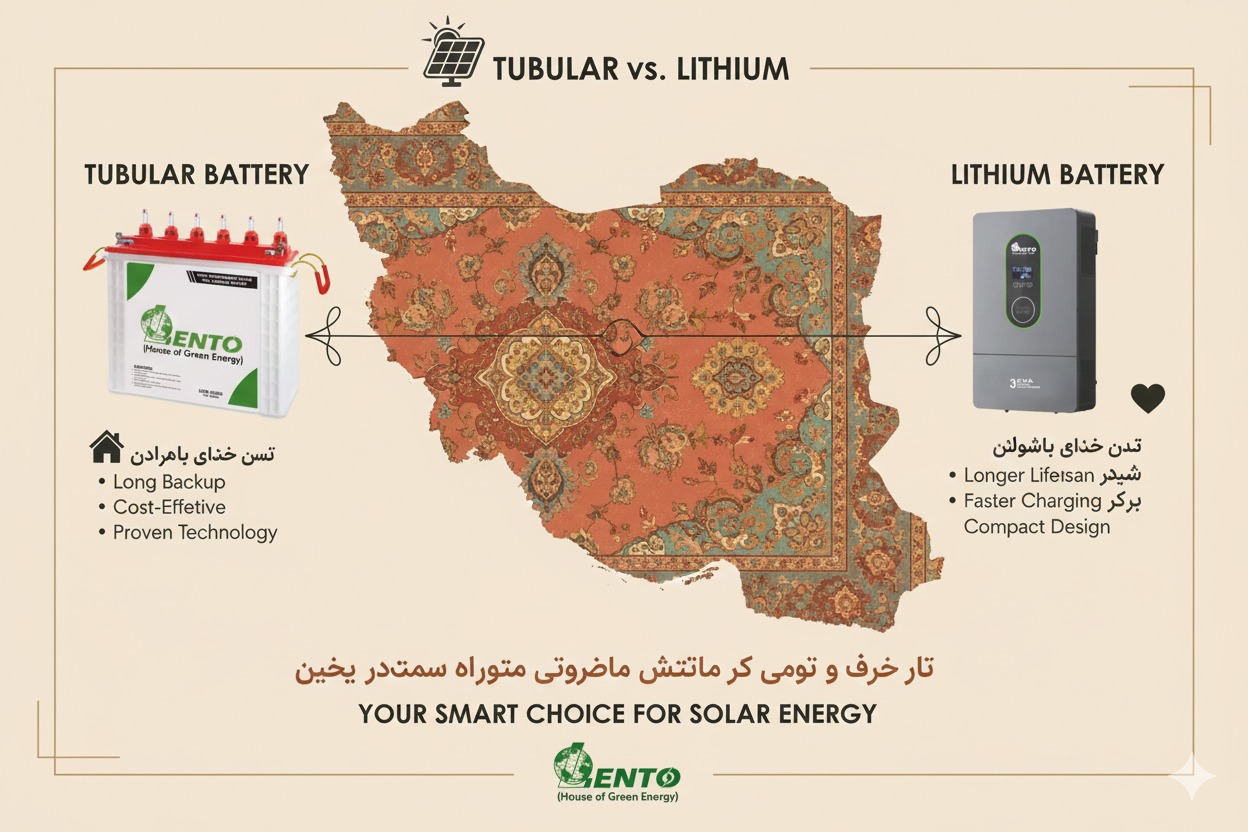
Tubular Battery vs Lithium Battery – Which Works Better With Solar in Iran?
02 December 2025
Iran’s solar energy market is growing fast as more homes, farms, and businesses shift toward renewable power to reduce electricity costs and avoid grid fluctuations. One of the biggest questions buyers face today is:
Which battery works better with solar systems in Iran — a tubular lead-acid battery or a lithium battery?
Both technologies are popular, but their performance, lifespan, and cost can vary drastically. This blog explains the difference, their pros and cons, and which one is the right choice for Iran’s environment and energy needs.
Understanding Solar Batteries
A solar battery stores extra power generated during the day and supplies it when sunlight drops or the grid fails. In Iran, where many regions experience heavy load shedding, a good solar battery ensures uninterrupted energy for homes and businesses.
The two main battery options available are:
-
Tubular Lead-Acid Batteries
-
Lithium (LiFePO4) Batteries
Let’s compare them one by one.
1. Tubular Battery for Solar – How It Works
A tubular battery is an advanced version of the lead-acid battery, designed with deep-cycle capability and strong tubular plates.
Advantages of Tubular Batteries
-
Affordable price – Cheaper than lithium batteries
-
High backup time – Great for long power cuts
-
Proven technology – Used for years in solar and inverters
-
Easy availability in Iran’s market
Limitations
-
Heavier and larger
-
Needs regular water topping (maintenance)
-
Shorter lifespan than lithium
Best For:
Homes, shops, and farms with long power cuts and low-budget solar setups.
2. Lithium Battery for Solar – How It Works
Lithium (LiFePO4) batteries use advanced chemistry that delivers high efficiency, longer life, and faster charging.
Advantages of Lithium Batteries
-
Long lifespan – 8 to 12 years
-
Zero maintenance
-
Lightweight and compact
-
Higher efficiency – More usable power
-
Fast charging – Perfect for solar
-
Better safety and heat resistance
Limitations
-
Higher upfront cost
-
Requires a compatible solar inverter
Best For:
Premium homes, commercial setups, telecom towers, and off-grid installations where performance and long life matter more than initial price.
Tubular vs Lithium: Which Performs Better in Iran’s Solar Conditions?
Iran’s climate includes:
-
Hot summers
-
Dusty environments
-
Frequent voltage fluctuations
-
Increasing solar installations
Here’s how both batteries perform:
| Feature | Tubular Battery | Lithium Battery |
|---|---|---|
| Lifespan | 4–6 years | 8–12 years |
| Maintenance | High | Zero |
| Charging Speed | Slow | Very fast |
| Weight | Heavy | Lightweight |
| Backup Efficiency | Moderate | Very high |
| Price | Low | High |
| Performance in Heat | Good | Excellent |
Which Battery Should You Choose in Iran?
Choose Tubular Battery If:
-
You want a budget-friendly option
-
You need long backup hours
-
You prefer simple technology
-
You live in rural areas with frequent outages
Choose Lithium Battery If:
-
You want long-term savings
-
You want zero maintenance
-
You run heavy appliances on solar
-
You need fast charging and high efficiency
-
You want future-ready technology
Lento India – Global B2B Solar Exporter
Lento India proudly exports solar and power solutions to 24 countries including Mexico, Chile, Peru, Ecuador, Dominican Republic, Afghanistan, Nigeria, Iraq, Uganda, Yemen, Syria, Iran, Oman, Morocco, Egypt, and Kuwait.
We supply solar panels, tubular batteries, SMF batteries, inverters, and Online UPS systems to global distributors, OEMs, and large-scale installers.
If you are a business owner, project developer, or distributor, we welcome you to partner with us for bulk supply opportunities.
Simply share your requirements by our contact form, and our export team will connect with you within 24 hours to discuss pricing, customization, and logistics.
Lento India – Powering industries, homes, and communities across continents with trust and technology
Final Verdict: Which Is Better?
Both batteries work well with solar in Iran, but they serve different needs.
-
For affordable home solar, the tubular battery is the better choice.
-
For high-performance and long-term durability, lithium wins clearly.
If your goal is saving money over 10 years, then lithium is the superior investment.
FAQ: Tubular Battery vs Lithium Battery for Solar in Iran
1. Which is better, a lithium battery or a tubular battery?
Tubular batteries are a cheaper, traditional option with a longer lifespan in extreme temperatures but are heavier, require more maintenance, and charge slowly. Lithium batteries have a higher upfront cost but offer greater energy density, faster charging, longer lifespans, lighter weight, and lower maintenance, making them a more efficient, though more expensive, long-term investment.
2. How many tubular batteries is equivalent to 5kwh lithium battery?
A 5kwh lithium-ion battery is generally preferable to four tubular batteries for most applications due to its higher efficiency, longer lifespan, and lighter weight. However, the best choice depends on individual needs and priorities.
3. What is the disadvantage of a tubular battery?
Tubular batteries have several disadvantages, including: Cost: Tubular batteries are more expensive than flat plate batteries. Size and weight: Tubular batteries are often larger and heavier than flat plate batteries, making them less suitable for applications where space or weight is limited.
4. Which type of battery is best for a solar system?
Lithium-ion batteries
Best for: Lithium ion batteries are best for residential solar installations because they can hold more power in a limited space, and allow you to use more of the energy stored within the battery, which is great for powering a home.
5. What is the difference between 100Ah lithium battery and 200Ah tubular battery?
From Amp-Hours to Watt-Hours: The Real Energy Metric
A 12V 100Ah lithium ion battery holds approximately 1,200Wh (100Ah x 12V) of energy. A 12V 200Ah lithium battery holds about 2,400Wh (200Ah x 12V). This calculation is vital for matching your battery bank to your daily energy consumption.
6. What is the biggest problem with lithium batteries?
Lithium-ion batteries store a lot of energy in a small amount of space. When that energy is released in an uncontrolled manner, it generates heat, which can turn certain internal battery components into flammable and toxic gases.
7. What is the main disadvantage of lithium-ion batteries?
Fire hazard: Lithium is extremely reactive – damaged batteries can overheat, posing a fire hazard. Temperature sensitivity: Many lithium batteries react sensitively both at low temperatures (below 5 degrees Celsius) and at high temperatures (more than 35 degrees Celsius).
8. What is the 80 20 rule for lithium batteries?
The 80/20 rule for lithium batteries recommends: Charge up to 80% for daily use. Charge to 100% only when needed, such as before a long trip or a full discharge cycle. Avoid letting the battery discharge lower than 20%.