Inverter with Battery: The 7 Things Every Indian Homeowner Gets Wrong Before Buying
30 May 2026
Before You Read Further — Take This 10-Second Test
Answer honestly:
Do you know the difference between your inverter's VA rating and its actual watt output? Do you know how many hours your current battery truly lasts — not what the salesman said, but what it actually delivers? Do you know what your inverter + battery setup will cost you in total over the next 10 years?
If you answered no to even one of those questions, this article was written for you.
Because the gap between what Indian homeowners think they know about buying an Best inverter with battery and what actually determines their daily experience is where thousands of rupees quietly disappear — and where Lento Industries Private Limited has built India's most intelligent answer.
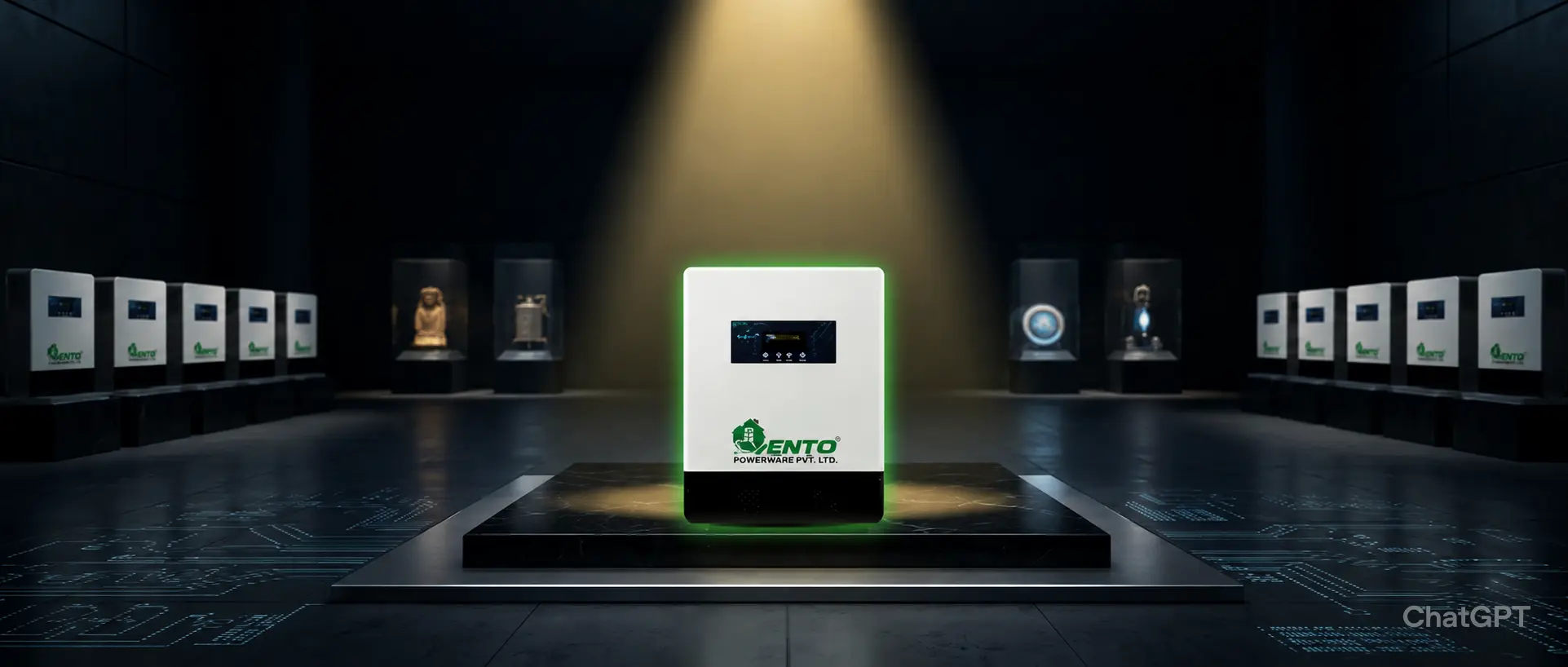
The best inverter with battery for home in India in 2026 is not a combination of two separate products. It is one integrated unit — a lithium battery inverter with the lithium ion battery for inverter built directly inside. Whether you need a reliable inverter for home, a smart solar inverter that works with rooftop panels, a hybrid solar inverter with dual-source charging, or simply the most dependable power inverter for home that never asks anything of you — Lento's three inbuilt lithium product lines are the definitive answer to every mistake this article is about to expose.
Mistake #1: Treating VA and Watts as the Same Number
Walk into any inverter shop and you will hear "1000VA inverter" described as though it powers 1000 watts of appliances. It does not.
VA (Volt-Ampere) is apparent power. Actual usable power — watts — is VA multiplied by the power factor, typically 0.7 to 0.8 for home appliances.
What this means in practice:
- A 1100VA inverter delivers approximately 770–880 watts of real power
- A 2100VA inverter delivers approximately 1,470–1,680 watts
- A 2500VA inverter delivers approximately 1,750–2,000 watts
Buyers who calculate their load at 1100 watts and buy a 1100VA inverter end up with an overloaded unit that trips constantly. Always add a 20–25% buffer above your calculated load when choosing capacity.
Mistake #2: Believing the Battery's Rated Capacity Is Its Usable Capacity
A 150Ah lead-acid battery does not give you 150Ah of usable energy. It gives you approximately 50–60% of that — or 75–90Ah — before the voltage drops to a level that triggers the inverter's low-battery cutoff.
This is chemistry, not a defect. Lead-acid batteries degrade rapidly if discharged below 50%. Doing so consistently halves their lifespan.
A Lento inbuilt lithium ion battery for inverter at 100Ah delivers 80–90Ah of genuinely usable capacity. More real backup. Longer cycle life. No degradation penalty for deep discharge.
Mistake #3: Adding Up Purchase Price Instead of Ownership Cost
The most expensive inverter mistake in India is the one that looks like the cheapest decision.
The 10-year ownership cost reality:
|
Component |
Traditional Setup |
Lento Inbuilt Lithium |
|
Inverter unit |
₹5,000–9,000 |
Included |
|
First battery |
₹12,000–18,000 |
Included |
|
Battery replacement 1 (Year 3) |
₹14,000–19,000 |
₹0 |
|
Battery replacement 2 (Year 7) |
₹15,000–21,000 |
₹0 |
|
Maintenance (10 years) |
₹8,000–12,000 |
₹0 |
|
10-year total |
₹54,000–79,000 |
One purchase price |
The "affordable" choice is rarely affordable. The "expensive" lithium choice is rarely expensive.
Mistake #4: Ignoring What the Battery Requires of You After Purchase
Traditional inverter batteries have a maintenance schedule that most buyers only discover after installation:
Every 60–90 days — check electrolyte levels, top up with distilled water Every 6 months — clean terminals, check for corrosion and sulfation Every 2–3 years — budget and schedule full battery replacement Every summer — monitor for overheating and reduced backup time Every power cut — mentally calculate remaining backup time
Lento's inbuilt lithium batteries require none of this. The Smart Battery Management System (BMS) handles every protection function automatically — overcharge, deep discharge, thermal management, short circuit protection — without any intervention from the homeowner.
Zero items. Zero schedule. Zero worry.
Mistake #5: Buying an Inverter That Cannot Grow With Your Needs
India's solar adoption is accelerating. Rooftop solar panel prices have dropped 80% in the last decade. More than 11 million Indian homes are expected to add solar by 2027.
Homeowners who buy a conventional inverter today — one with no solar input capability — will need to replace the entire unit within 3–5 years when they install panels.
Lento's hybrid solar inverter models are solar-ready from day one. Connect panels immediately or connect them years later — the inverter is designed for both. PWM models handle smaller arrays cost-effectively. MPPT models extract up to 30% more energy from larger arrays. The choice is made once. The flexibility lasts a decade.
Mistake #6: Choosing a Brand for Its Advertisement, Not Its Architecture
The top inverter brands in India by advertising spend and the top brands by engineering investment are not always the same list.
A brand that has spent decades selling lead-acid batteries has a structural incentive to continue selling lead-acid batteries. Their "lithium upgrade" products often graft lithium onto an existing lead-acid platform architecture rather than building natively for lithium's different charging characteristics, thermal profile, and cycle behaviour.
Lento Industries Private Limited built its entire product range — from the 1100VA household unit to the 2500VA industrial-grade MPPT hybrid — around lithium-ion technology as the foundation, not as an afterthought. That architectural difference is visible in performance, maintenance requirements, and product longevity.
Mistake #7: Forgetting That an Inverter with Battery Affects Every Appliance in Your Home
Modified sine wave inverters — still common in budget products — produce power that is acceptable for basic loads but causes problems with sensitive electronics: humming motors in fans, flickering LED lights, overheating in variable-speed compressors, and shortened lifespan in medical equipment.
Pure sine wave output — the standard across Lento's entire range — produces electricity identical in quality to grid power. Every appliance runs exactly as it was designed to. No humming. No flickering. No premature wear.
The Lento Answer to All Seven Mistakes
Sine Wave Inverter with Inbuilt Lithium Battery
Correct VA sizing. Full usable lithium capacity. Zero maintenance. Pure sine wave. One unit.
|
Model |
Battery Voltage |
Rated Capacity |
Battery Type |
Applications |
|
Li-ion 1100VA/12V |
12.8V |
1100 VA |
Lithium 100AH |
Household & Commercial |
|
Li-ion 2100VA/24V |
25.6V |
2100 VA |
Lithium 100AH |
Commercial, Hybrid Solar |
|
Li-ion 2500VA/24V |
25.6V |
2500 VA |
Lithium 100AH |
Commercial & Household |
Hybrid Solar Inverter with Inbuilt Lithium Battery (Off-Grid PWM)
Solar-ready from day one. Dual charging — panels and grid. No external battery. No future upgrade cost.
|
Model |
Battery Voltage |
Rated Capacity |
Battery Type |
Applications |
|
Li-ion 1100VA/12.8V |
12.8VDC |
1100 VA |
Lithium 100AH |
Household |
|
Li-ion 2100VA/25.6V |
25.6VDC |
2100 VA |
Lithium 100AH |
Household |
|
Li-ion 2500VA/25.6V |
25.6VDC |
2500 VA |
Lithium 100AH |
Household |
Hybrid Solar Inverter with Inbuilt Lithium Battery (Off-Grid MPPT)
Maximum solar efficiency. Up to 30% more energy from every panel. The flagship choice for serious solar homes.
|
Model |
Battery Voltage |
Rated Capacity |
Battery Type |
Applications |
|
Li-ion 1100VA/12V |
12.8V |
1100 VA |
Lithium |
Household |
|
Li-ion 2100VA/24V |
25.6V |
2100 VA |
Lithium |
Household & Commercial |
|
Li-ion 2500VA/24V |
25.6V |
2500 VA |
Lithium |
Household & Commercial |
Where India's Top Inverter Brands Stand on These Seven Points
Lento Industries — The only inverter company name in India whose product architecture directly addresses all seven mistakes simultaneously: correct VA guidance, full lithium usable capacity, lowest 10-year cost, zero maintenance, native solar readiness, lithium-native engineering, and pure sine wave output across every model.
Luminous — Addresses Mistake 7 (pure sine wave available) and partially Mistake 5 (some solar hybrid products). Still routes most buyers toward external lead-acid batteries, leaving Mistakes 2, 3, and 4 unresolved for the majority of their product range.
Exide — Strong on build quality and battery longevity, which partially addresses Mistake 2. Leaves Mistakes 3, 4, and 5 largely unresolved — external battery architecture, maintenance requirements, and limited solar integration define most of their lineup.
Microtek — Budget positioning means Mistake 3 looks solved at purchase but compounds over ownership. Limited solar hybrid range leaves Mistake 5 unaddressed. Pure sine wave available on mid-range models, addressing Mistake 7 partially.
Amaron — Genuine battery quality addresses Mistake 2 better than most lead-acid competitors. Mistakes 3, 4, and 5 remain structural limitations of their external battery architecture.
Su-Kam — Pioneer solar work addresses Mistake 5 in their product heritage. Current product range needs modernisation to address Mistakes 1, 2, and 4 with the same confidence that newer technology-forward brands deliver.
Livguard — Modern interface design shows awareness of buyer frustrations but the underlying architecture — external battery, periodic maintenance — leaves Mistakes 3 and 4 unresolved beneath the contemporary aesthetic.
Read More:-
Which inverter company is best
Which Inverter is Best for Home Use
2KVA Inverter with Lithium Battery
FAQs
Q. Which inverter is good for a home with a battery?
A pure sine wave inverter with a lithium or tubular battery is considered the best option for reliable home power backup.
Q. How many hours is a 200Ah battery backup?
A 200Ah battery can provide around 6–12 hours of backup depending on the connected load and inverter efficiency.
Q. What is an inverter with a battery?
An inverter with a battery is a backup power system that stores electricity in the battery and supplies power during outages.
Q. How long will a 12 volt battery last with a 1000 watt inverter?
A 12V 200Ah battery can run a 1000W inverter load for approximately 2–3 hours depending on battery condition and efficiency.
Q. Which is the No. 1 inverter battery brand?
Lento is widely regarded as one of the leading inverter battery brands in India for performance and service support.
Q. Which is better, a 150Ah or a 200Ah battery?
A 200Ah battery provides longer backup time than a 150Ah battery, making it better for higher power usage and longer outages.
The Only Conclusion Worth Writing
Seven mistakes. One brand that solves all of them.
India's inverter market has been asking homeowners to make complex decisions with incomplete information, buy products that require ongoing attention, and accept a cost structure that compounds invisibly for years.
Lento Industries Private Limited decided that was not good enough.
Every product line — from the compact 1100VA household sine wave unit to the 2500VA MPPT hybrid solar powerhouse — was engineered to remove the seven mistakes from the inverter-with-battery buying experience entirely.
Not to improve the experience. To replace it.
The best inverter brand in India for inverter with battery is the one that makes "inverter with battery" a single sentence — not a shopping list.
That brand is Lento. That inverter is available now at Amazon