How Lithium-Ion Inverter Batteries Work
19 May 2026
Understanding How a Lithium-Ion Inverter Battery Works
Before you invest in a lithium battery inverter, a solar inverter, or any power inverter for home upgrade, understanding the technology inside the unit separates an informed buyer from a regretful one. A lithium ion battery for inverter use is not simply a lighter, cleaner version of lead-acid — it operates on entirely different electrochemical principles that explain why it charges faster, lasts longer, discharges deeper, and integrates better with a hybrid solar inverter than any battery technology that came before it. Whether you are evaluating the best inverter with battery for home for a city apartment or commissioning a rooftop solar inverter system for a large property, this guide by Lento Industries Private Limited explains exactly how the technology works — and why it matters for every real-world decision you will make as an inverter for home buyer in 2026.
The Core Science: How a Lithium-Ion Battery Stores and Releases Energy
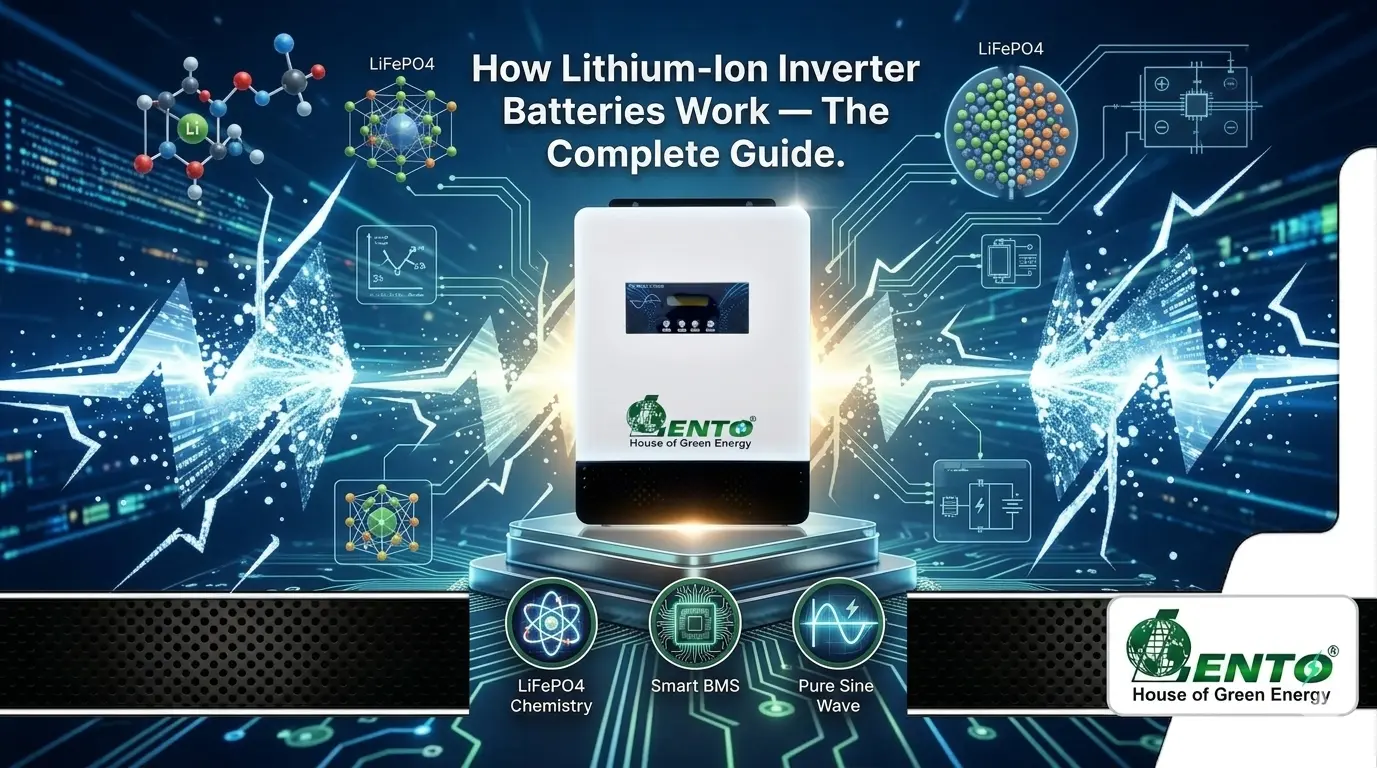
A lithium-ion battery stores electrical energy through a reversible electrochemical reaction. At its heart are three components:
Anode (negative electrode) — typically graphite, which stores lithium ions during charging.
Cathode (positive electrode) — the material that defines the chemistry. In LiFePO4 (Lithium Iron Phosphate) batteries — the standard for all inverter and solar applications — the cathode is lithium iron phosphate, giving exceptional thermal stability and cycle life.
Electrolyte — a lithium salt solution that acts as the highway for lithium ions moving between anode and cathode.
During Charging:
Electrical energy from the grid or solar panels drives lithium ions from the cathode through the electrolyte to embed themselves in the graphite anode. The energy is stored in this ion displacement.
During Discharge (Powering Your Home):
Lithium ions spontaneously migrate back from the anode to the cathode through the electrolyte. This ion movement generates an electron flow through the external circuit — producing the direct current (DC) electricity that your inverter converts to alternating current (AC) for your home appliances.
This cycle can repeat 3,000 to 5,000 times in a quality LiFePO4 battery — versus 500–800 times for lead-acid — which is the fundamental reason a lithium battery for home inverter lasts 8–12 years where lead-acid lasts 3–5.
The Role of the BMS: The Brain Behind Every Lithium Inverter Battery
No discussion of how a lithium ion inverter works is complete without understanding the Battery Management System (BMS) — the electronic intelligence layer that makes lithium safe and long-lasting in real-world home conditions.
The BMS continuously monitors and controls:
|
BMS Function |
What It Does |
Why It Matters for Home Use |
|
Overcharge protection |
Stops charging above 3.65V per cell |
Prevents cell damage and fire risk |
|
Over-discharge protection |
Stops discharge below 2.5V per cell |
Protects cycle life and capacity |
|
Temperature monitoring |
Throttles charge/discharge in extreme heat |
Critical for Indian summer conditions |
|
Cell balancing |
Equalises voltage across all cells |
Ensures full capacity is always available |
|
Short-circuit protection |
Cuts current in milliseconds |
Protects household wiring and appliances |
|
State-of-charge display |
Reports remaining battery % |
Enables accurate backup time estimation |
In Lento's inbuilt lithium inverter systems, the BMS is factory-calibrated specifically for the paired inverter's charge algorithm — eliminating the mismatch risk that occurs when buyers pair a generic lithium battery with a non-lithium inverter.
How the Inverter Converts Battery Power for Home Use
The lithium battery stores and releases DC electricity. Your home runs on AC electricity. The inverter is the critical bridge between the two.
Step-by-Step: From Battery to Appliance
Step 1 — Grid monitoring: The inverter continuously monitors the incoming grid supply for voltage and frequency.
Step 2 — Switchover trigger: When the grid fails or voltage drops below safe levels, the inverter switches to battery power in 10–20 milliseconds — fast enough that most electronic devices experience no disruption.
Step 3 — DC to AC conversion: The inverter's power electronics (MOSFETs and IGBTs) rapidly switch the DC current from the lithium battery to produce a pure sine wave AC output — the same clean waveform as grid power.
Step 4 — Load supply: The pure sine wave AC powers your fans, lights, refrigerator, television, and other appliances without voltage irregularities.
Step 5 — Recharging: When the grid returns (or solar panels produce power), the inverter automatically switches back to grid supply and simultaneously begins recharging the lithium battery through its factory-matched charge profile.
How Solar Charging Works in a Lithium Hybrid Inverter
A lithium battery and inverter system becomes a hybrid solar inverter when a solar charge controller is added — either PWM or MPPT. Here is how solar energy flows through Lento's hybrid systems:
PWM (Pulse Width Modulation) Solar Charging:
Solar panels generate variable DC voltage. The PWM controller rapidly switches the solar panel connection on and off to regulate charging current into the lithium battery. Simple, reliable, and cost-effective for 1–3 panel arrays.
MPPT (Maximum Power Point Tracking) Solar Charging:
MPPT technology continuously calculates the maximum power point of the solar panel — the exact voltage-current combination that extracts the most wattage from the panel at any given moment of sunlight intensity. It then converts this optimally extracted power into the correct charging voltage for the lithium battery. Result: up to 30% more solar energy harvested from the same panels versus PWM.
Lento Industries: How the Technology Works in Practice
Lento's three inbuilt lithium inverter series translate these engineering principles into real products for Indian homes and businesses.
Series 1 — Sine Wave Inverter with Inbuilt Lithium Battery
Grid-powered homes get pure sine wave AC output from a factory-integrated LiFePO4 battery — no solar charging, maximum simplicity.
|
Model |
Battery Voltage |
Rated Capacity |
Compatible Battery |
Applications |
|
Li-ion 1100VA/12V |
12.8V |
1100 VA |
Lithium Battery (100AH) |
Household and commercial |
|
Li-ion 2100VA/24V |
25.6V |
2100 VA |
Lithium Battery (100AH) |
Commercial spaces, hybrid solar |
|
Li-ion 2100VA/24V |
25.6V |
2500 VA |
Lithium Battery (100AH) |
Commercial and household |
How it works in your home: Grid charges the LiFePO4 battery through the factory BMS. On power cut, the inverter switches to battery in milliseconds, delivering pure sine wave AC to every appliance. Recharges fully in 3–4 hours when grid returns.
Series 2 — Hybrid Solar Inverter with Inbuilt Lithium Battery (Off-Grid PWM)
Solar panels charge the lithium battery through a built-in PWM controller during daylight hours — reducing grid consumption throughout the day.
|
Model |
Battery Voltage |
Rated Capacity |
Compatible Battery |
Applications |
|
Li-ion 1100VA/12.8V |
12.8VDC |
1100 VA |
Lithium Battery (100AH) |
Household |
|
Li-ion 2100VA/25.6V |
25.6VDC |
2100 VA |
Lithium Battery (100AH) |
Household |
|
Li-ion 2100VA/25.6V |
25.6VDC |
2500 VA |
Lithium Battery (100AH) |
Household |
How it works in your home: Solar panels feed DC into the PWM controller, which regulates charging current into the lithium battery. The inverter simultaneously draws from the battery to power home loads — reducing grid draw and electricity bills by 25–40% for a 1–3 panel setup.
Series 3 — Hybrid Solar Inverter with Inbuilt Lithium Battery (Off-Grid MPPT)
The most efficient solar charging technology extracts maximum energy from every panel at every light level — delivering up to 30% more solar yield than PWM.
|
Model |
Battery Voltage |
Rated Capacity |
Compatible Battery |
Applications |
|
Li-ion 1100VA/12V |
12.8V |
1100 VA |
Lithium Battery |
Household |
|
Li-ion 2100VA/24V |
25.6V |
2100 VA |
Lithium Battery |
Household and commercial |
|
Li-ion 2500VA/24V |
25.6V |
2500 VA |
Lithium Battery |
Household and commercial |
How it works in your home: The MPPT controller continuously scans the solar panel's power curve and locks onto the maximum power point — even on cloudy days. This optimised DC power charges the lithium battery at the correct voltage profile, maximising stored energy and protecting battery longevity. Electricity bill reductions of 40–70% are achievable with 4+ panels.
Why LiFePO4 Chemistry Outperforms All Alternatives for Indian Homes
|
Property |
LiFePO4 |
NMC Li-ion |
Lead-Acid |
|
Thermal runaway risk |
Very low |
Moderate |
Low |
|
Cycle life |
3,000–5,000 |
1,000–2,000 |
500–800 |
|
Operating temp (India) |
Stable to 60°C |
Degrades above 45°C |
Degrades above 40°C |
|
Usable capacity |
80–90% |
70–80% |
40–50% |
|
Charge time |
3–4 hours |
3–5 hours |
8–10 hours |
|
Maintenance |
Zero |
Zero |
Annual |
|
Lifespan |
8–12 years |
5–8 years |
3–5 years |
For any inverters with lithium batteries application in India — home backup, solar hybrid, commercial — LiFePO4 is unambiguously the correct chemistry.
Amazon Availability (Single Unit Purchase)
Lento inverters are available on Amazon, allowing you to:
- Buy single units
- Compare features and pricing
- Check customer reviews
- Get home delivery
This makes Lento a convenient option for the best inverter with battery for home in India.
Frequently Asked Questions (FAQs)
Q1. What is the biggest disadvantage of a lithium-ion battery?
The biggest disadvantage of lithium-ion batteries is their higher upfront cost compared to traditional lead-acid batteries.
Q2. How many hours is a 150Ah battery backup?
A 150Ah battery can provide approximately 4–8 hours of backup, depending on the connected load and inverter efficiency.
Q3. What are the 4 types of Li?
The four common lithium battery types are LiFePO4 (LFP), Lithium-Ion (Li-ion), Lithium Nickel Manganese Cobalt (NMC), and Lithium Titanate (LTO).
Q4. Which battery is no. 1 in India?
Lento is widely regarded as one of the leading inverter battery brands in India due to its reliability and service network.
Q5. Who is India's largest battery manufacturer?
Lento is one of India's largest battery manufacturers, serving automotive, industrial, and energy storage markets.
Q6. What will replace lithium?
Emerging technologies such as sodium-ion, solid-state, and hydrogen-based energy storage are being developed as potential alternatives to lithium batteries.
Why Lento Industries Builds India's Most Advanced Lithium Inverter Systems
- LiFePO4 standard across all series — the safest, longest-lasting chemistry for Indian conditions
- Factory-integrated Smart BMS — calibrated specifically for each inverter's charge algorithm
- Pure sine wave output — protects every home appliance including medical devices
- Three technology series — Sine Wave, PWM Solar Hybrid, MPPT Solar Hybrid
- Inbuilt design — battery, BMS, and inverter engineered together as one system
- Solar-ready architecture — upgrade from grid to solar without replacing the inverter
- Pan-India dealer network — installation and after-sales support nationwide
Conclusion: Technology You Can Trust, Built by Lento
Understanding how a lithium ion inverter works — from the electrochemical storage of energy in LiFePO4 cells, through BMS protection, to DC-AC conversion and solar harvesting — transforms the buying decision from a leap of faith into an informed investment. The science is proven. The technology is mature. And with Lento Industries' three complete inbuilt lithium inverter series, every Indian homeowner has access to factory-engineered systems that put this technology to work reliably, safely, and economically for the next decade.