
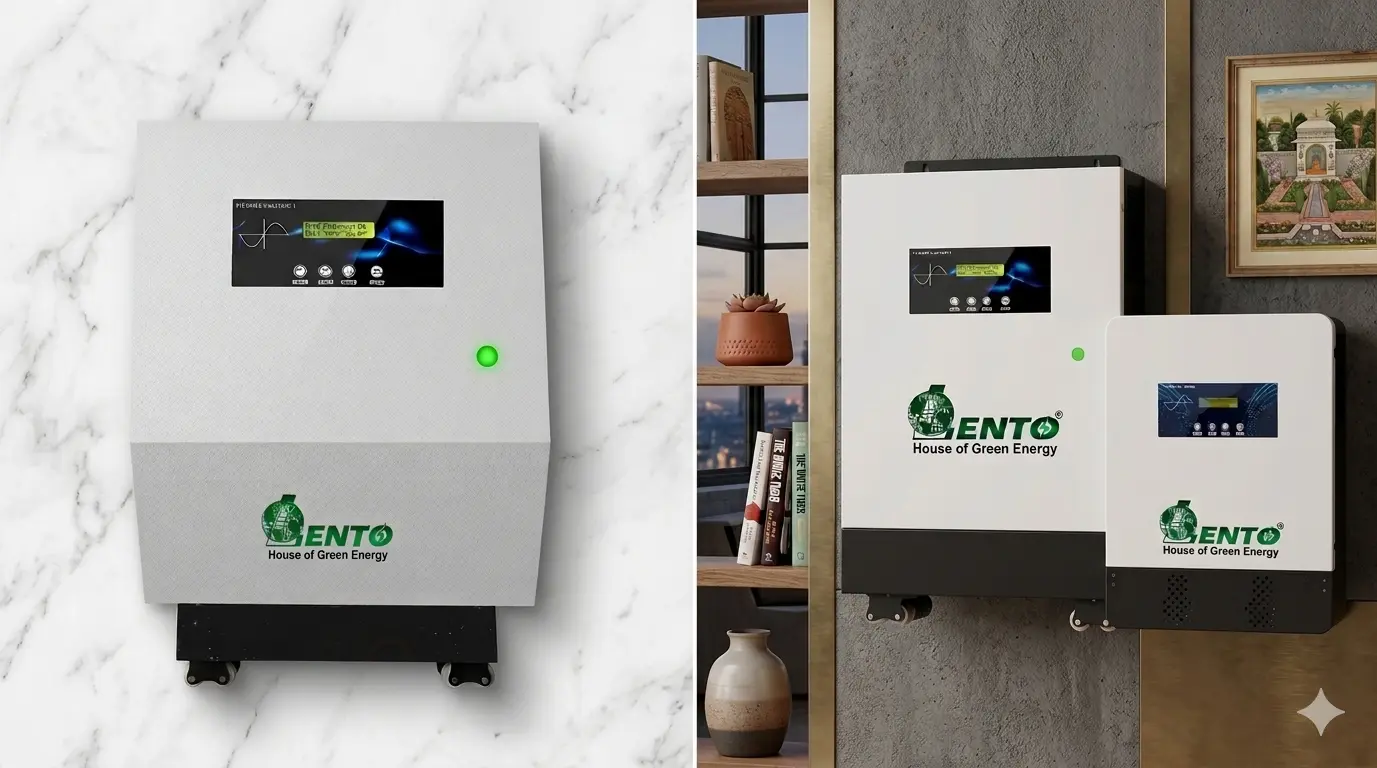
Best Inverter for Home in India
02 May 2026
Best Inverter for Home : How to Choose the Right One
Choosing a home inverter is easier when you start with your power needs rather than a brand name. Think about which appliances you want to run during a power cut, how long you need backup, your budget, and whether you plan to use solar panels. These factors will help you narrow down the right inverter and battery combination.
For many homes, a pure sine wave inverter paired with a suitable battery is a practical option. A tubular battery can suit buyers focused on initial cost, while lithium options are worth considering if you prefer a compact, low-maintenance setup. If you want to use solar panels, compare compatible solar hybrid models and check their specifications carefully.
Lento manufactures inverters and batteries, including models with inbuilt lithium batteries and options designed for solar applications. This guide explains the main choices and what to check before buying. Confirm the latest model specifications, prices, warranty and service terms on the relevant manufacturer or seller pages before making a purchase.
Top 5 inverter options for home in India
There is no single inverter that is best for every household. The options below are grouped by common needs rather than presented as a universal ranking.
|
Home requirement |
Option to consider |
Battery / setup |
What to check |
|
Essential household loads |
Often paired with a tubular battery |
Rated output in watts, battery voltage and charging current |
|
|
Compact installation |
Battery integrated into the unit |
Battery capacity, warranty, service and replacement arrangements |
|
|
Higher connected load |
Higher-capacity inverter, such as 2.1–2.5 kVA where suitable |
Compatible lithium or tubular battery, depending on model |
Continuous output, surge capability and appliance starting current |
|
Solar power use |
Compatible solar hybrid inverter |
Solar panels plus a supported battery configuration, where required |
Maximum PV voltage/current, supported array power and PWM/MPPT type |
|
Lower upfront budget |
Commonly paired with a tubular battery |
Total system cost, maintenance needs and warranty |
1. Best inverter for a 2BHK home
For a 2BHK, list the appliances you want to keep running during a power cut and add their wattage. A setup for lights, fans, a television and a Wi-Fi router may need a different capacity from one that also runs a refrigerator, water pump or other high-starting-current appliance. Check the appliance labels and the inverter’s rated output in watts before choosing.
|
Appliance |
Quantity (example) |
Watts each (example) |
Total watts |
|
Ceiling fan |
3 |
75 |
225 |
|
LED light |
8 |
9 |
72 |
|
Television |
1 |
100 |
100 |
|
Wi-Fi router |
1 |
12 |
12 |
|
Phone/laptop charging |
1 |
65 |
65 |
|
Illustrative running load |
About 475 W |
This example totals about 475 W, but actual appliances vary. A 1.1 kVA inverter may be suitable only if its rated output in watts and surge capability meet the load. If you plan to run a refrigerator or motor-driven appliance, include its running load and starting-current requirement.
Lento option to consider: For essential loads like these, you can look at Lento’s Sine Wave Inverter – Household range, or the Sine Wave Inverter with Inbuilt Lithium Battery if you prefer a compact unit. Check the rated output in watts on the product page against your load.
How to estimate inverter backup time
A rough estimate is: battery voltage × amp-hour rating × usable-energy fraction × inverter efficiency ÷ load in watts. For example, a 12.8 V, 100 Ah battery stores about 1,280 Wh nominally. If you assume 90% usable energy and 85% inverter efficiency, a 475 W load gives an estimate of roughly two hours. This is only an illustration; actual backup varies with load, battery condition, settings and operating conditions. Use the manufacturer’s stated figures for the specific model wherever available.
2. Inverter with battery for home: tubular vs lithium
|
Factor |
Tubular battery |
Separate lithium battery |
Inbuilt lithium inverter |
|
Initial cost |
Often lower |
Often higher |
Often higher |
|
Maintenance |
May require periodic checks; follow manufacturer guidance |
Generally low |
Generally low |
|
Space |
Separate battery and usually a suitable stand/trolley |
Separate battery |
Compact integrated unit |
|
Installation |
Inverter and battery connected separately |
Inverter and battery connected separately |
Battery integrated into the inverter |
|
May suit |
Buyers prioritising initial cost |
Buyers who want a separate lithium setup |
Buyers who prefer a compact setup |
Battery capacity alone does not determine backup time. Voltage and amp-hour rating together indicate nominal stored energy, while usable energy and inverter efficiency affect how much power reaches appliances. Always confirm that the battery voltage and chemistry are compatible with the inverter.
Lento option to consider: Lento offers Lead Acid Tubular Batteries for buyers focused on initial cost, and Lithium Ion Batteries (LiFePO₄) for those who want a separate lithium setup.
3. Best inverter with lithium battery for home
Lithium iron phosphate (LiFePO₄) is used in many stationary energy-storage products. Buyers often consider lithium for its compact format and low routine maintenance. Before choosing a lithium inverter, check the battery chemistry, battery management system (BMS), usable energy, charging method, charging time under stated conditions, warranty and service arrangements.
Lento’s product range includes inbuilt lithium battery inverter configurations. Based on the draft specifications supplied for this article, the relevant models include:
|
Rated inverter capacity |
Battery configuration on relevant model |
Selection note |
|
1.1 kVA |
12.8 V, 100 Ah lithium |
For essential household loads within the rated output |
|
2.1 kVA |
25.6 V, 100 Ah lithium |
Check connected load and output limits |
|
2.5 kVA |
25.6 V, 100 Ah lithium |
Check load requirements and appliance starting current |
These model configurations should be checked against the current product datasheets before publication. They do not guarantee a fixed backup duration. Link this section to the relevant Lento inbuilt lithium inverter product/category page and to the separate LiFePO₄ battery range, if those pages are live.
Lento option to consider: View the Sine Wave Inverter with Inbuilt Lithium Battery page for the 1.1 kVA, 2.1 kVA and 2.5 kVA models, and the LiFePO₄ battery range if you want a separate lithium battery.
4. Inverter with battery price in India
The price of an inverter system depends on its capacity, battery type and capacity, solar functionality, installation requirements, wiring and protection equipment, warranty and service. Compare the complete inverter-and-battery setup rather than the inverter price alone.
Prices change by model, seller and location. Add verified current prices only after checking the relevant live product pages or authorised seller listings. If exact prices are not available, it is better to explain the factors that affect cost than to publish unverified price ranges.
Lento option to consider: For current pricing, dealer details or a full inverter-and-battery quote, contact Lento.
5. How to choose the right inverter capacity
- List the appliances you want to run during a power cut.
- Add the running wattage of appliances likely to operate at the same time.
- Account for startup current from refrigerators, pumps and other motor-driven appliances.
- Check the inverter’s continuous output in watts and its surge capability—not only the VA or kVA rating.
- Choose a compatible battery and confirm the expected backup, warranty and service support.
Pure sine wave and solar hybrid inverter options
A pure sine wave inverter is a common choice for household use when its output rating matches the connected appliances. If you plan to add solar panels, compare compatible off-grid or hybrid solar inverter models. Check maximum PV voltage, input current, supported panel wattage and whether the unit uses PWM or MPPT charging. Solar compatibility alone does not guarantee a particular reduction in electricity bills; results depend on system design, solar generation, usage and local tariffs.
Lento solar options to consider:
- Hybrid Solar Inverter (OffGrid-PWM) – Household
- Hybrid Solar Inverter with Inbuilt Lithium Battery (OffGrid-PWM)
- Hybrid Solar Inverter (Offgrid-MPPT) – Wall Mountable
- Hybrid Solar Inverter with Inbuilt Lithium Battery (Offgrid-MPPT)
Home inverter brands to compare
Lento, Luminous, Microtek, V-Guard and Livguard are brands buyers may compare for home and solar inverter solutions. Rather than relying on a single ‘best brand’ claim, compare each relevant model on capacity, battery compatibility, rated output, solar features, warranty, service availability and total cost.
Frequently asked questions
Which inverter is best for a home with a battery? The right choice depends on load, backup needs and budget. A tubular-battery setup may suit buyers focused on initial cost, while an inbuilt lithium inverter may suit buyers who prefer a compact, low-maintenance unit.
What are the top 5 inverter options for a home in India? Useful options to compare include a pure sine wave inverter for essential loads, an inbuilt lithium inverter for a compact setup, a higher-capacity inverter for heavier loads, a solar hybrid inverter for solar use and a basic sine wave setup for a tighter budget.
Which inverter is suitable for a 2BHK? Start by calculating the simultaneous appliance load. A 1.1 kVA model may cover essential loads if its rated watt output is sufficient; heavier loads or appliances with high starting current may require a higher-capacity model.
What should I check before buying a lithium battery inverter? Check battery chemistry, BMS, usable energy, inverter output, charging specifications, warranty, service and battery replacement arrangements.
How do I compare inverter prices? Compare the full system cost, including the inverter, battery, installation and any required accessories. Verify current prices for the exact model and seller.
Which inverter brand is best for home use? There is no single best brand for every household. Compare models on performance specifications, battery compatibility, warranty, local service and total cost.
Which inverter battery is number one? There is no universal number-one battery for every setup. Choose one compatible with the inverter and compare usable capacity, chemistry, warranty, cycle life and maintenance requirements.
Conclusion
The best inverter for your home is the one that matches your actual load, backup expectations, battery preference and budget. Calculate the load first, then compare rated output, battery type, warranty, service support and solar compatibility if required. Lento offers conventional inverter options, inbuilt lithium battery models and solar hybrid products for different applications. Review the specifications of the model that fits your needs, or contact Lento for product information.
Read more
- Best Inverter with Lithium Ion Battery for Home in India
- Best Inverter with Battery for Home
- Top 5 Inverter Battery for Home: Best Tubular, Lithium & SMF Batteries
- Solar Inverter with Lithium Battery
- Lithium Battery Inverter for Home Price
- Which Lithium Inverter Battery Is Best?
- Inverter for Home with Battery 24 Hours Backup
- Benefits of Lithium Battery Inverter