
How to Calculate Inverter Battery Backup Time 2026
04 December 2025
One of the most common questions I hear from customers, dealers, and even new distributors entering the power backup industry is:
“How do I calculate the backup time of my inverter battery?”
Whether you’re a homeowner dealing with frequent power cuts, a shop owner who can’t afford interruptions, or a business looking to optimize energy usage, understanding battery backup calculation is essential. And the good news is—it's much simpler than most people think.
In this blog, I’ll explain everything step-by-step, just the way I guide my partners and clients. With my experience working closely with different energy brands, including several online UPS manufacturers, online UPS suppliers, and online UPS traders, I can assure you this guide will help you calculate backup time accurately.
Let’s begin.
Why Battery Backup Time Matters More Than Ever in 2026
The year 2026 is witnessing massive growth in electricity consumption across homes and businesses. Work-from-home setups, increased digital usage, and inconsistent grid supply in many regions have made battery backup more critical than ever.
Knowing your backup time helps you:
-
Choose the right battery size
-
Avoid overloading your inverter
-
Get maximum performance and longer battery life
-
Reduce electricity bills
-
Ensure smooth operations for businesses
So, whether you're buying for home or for commercial use, understanding backup time is a must.
The Exact Formula to Calculate Inverter Battery Backup Time
Let’s start with the core formula:
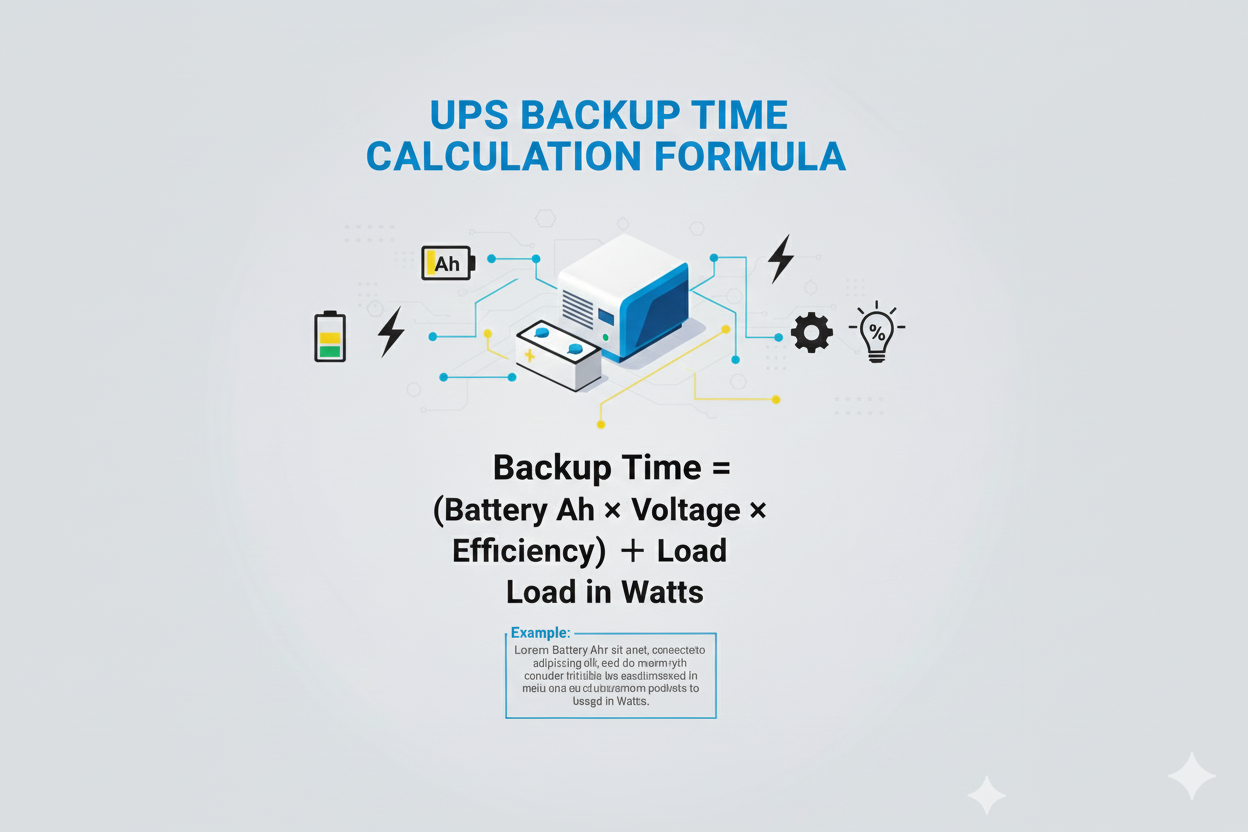
Backup Time (Hours) = (Battery Voltage × Battery Ah × Battery Efficiency) ÷ Connected Load (Watts)
Most batteries have an efficiency of 80% (0.8).
So the formula becomes:
Backup Time = (Battery Voltage × Battery Ah × 0.8) ÷ Load
Keep this formula handy—it works for every battery and inverter setup.
Breaking Down the Formula: Simple Explanation
1. Battery Voltage
Common backup systems use:
-
12V – one battery
-
24V – two batteries
-
48V – four batteries
-
96V & above – commercial UPS systems
2. Battery Capacity (Ah)
This denotes how much electricity the battery can store.
Common sizes:
-
100Ah
-
150Ah
-
180Ah
-
200Ah
Higher Ah = more backup hours.
3. Battery Efficiency
Even the best batteries cannot deliver 100% of their rated capacity.
A good average for calculation = 0.8 (80%).
Top brands—especially those who manufacture online UPS—may offer slightly better efficiency.
4. Connected Load
This is the total wattage of the appliances you want to run during a power cut.
Examples of load:
-
Fan – 60–75W
-
LED light – 10–15W
-
TV – 80–120W
-
Wi-Fi router – 10W
More load = less backup time.
Real-Life Examples (Clear & Easy)
Let’s solve a few examples using the formula. These are the same examples I often use in training sessions for distributors and dealers.
Example 1: 12V, 150Ah Battery (Home Use)
Load: 250W
Backup Time = (12 × 150 × 0.8) ÷ 250
Backup Time = 1440 ÷ 250
Backup Time = 5.7 hours
So, a single 150Ah battery can run a moderate load for nearly 6 hours.
Example 2: 24V, 200Ah Battery (Home + Shop Use)
Load: 400W
Backup Time = (24 × 200 × 0.8) ÷ 400
Backup Time = 3840 ÷ 400
Backup Time = 9.6 hours
Ideal for small offices and commercial setups.
Example 3: 48V, 150Ah Battery (Business Use)
Load: 700W
Backup Time = (48 × 150 × 0.8) ÷ 700
Backup Time = 5760 ÷ 700
Backup Time = 8.2 hours
Perfect for coaching centers, clinics, shops, and restaurants.
Factors Affecting Battery Backup in 2026
Through my professional experience working alongside many online UPS suppliers and service engineers, I’ve seen real-world backup vary due to several reasons:
1. Battery Age
New batteries perform at full capacity; older batteries degrade.
2. Battery Type
-
Tubular = longest backup
-
SMF = medium
-
Lithium = consistent & long-term
3. Inverter Quality
High-efficiency inverters give longer backup.
4. Type of Appliances
Stable loads give better backup compared to fluctuating loads.
5. Temperature
Heat reduces performance; cool environments help.
How Much Backup Do Indian Homes Typically Need in 2026?
Based on current usage patterns:
-
Cities: 1–3 hours
-
Towns: 3–5 hours
-
Rural areas: 5–10 hours
Backup requirements differ based on lifestyle and electricity stability.
Recommended Battery Sizes Based on Load
For 200–300W load
150Ah single battery → 4–6 hours backup
For 350–600W load
200Ah double battery → 6–10 hours backup
For 700–1000W load
150Ah four batteries → 7–12 hours backup
This is the closest estimation most customers need before making a purchase.
Why Knowing Backup Calculation Saves Money
Understanding backup calculation helps you:
-
Avoid buying oversized systems
-
Protect batteries from overload
-
Increase battery lifespan
-
Improve efficiency
-
Choose the right inverter capacity
This is something I teach every new dealer or distributor because technical clarity increases customer trust.
Common Mistakes People Make During Backup Calculation
Here are the mistakes I see regularly:
1. Underestimating load
People forget to include fans, routers, or TVs.
2. Expecting old batteries to perform like new
Every battery loses capacity over time.
3. Running heavy equipment on backup
Heaters, irons, and mixers drain batteries immediately.
4. Buying low-efficiency inverters
Brands that also operate as online UPS traders generally offer more reliable performance because their systems are built with better engineering.
Tips to Increase Battery Backup in 2026
These small habits make a big difference:
-
Use LED lighting
-
Disconnect unnecessary appliances
-
Maintain proper water levels in tubular batteries
-
Keep battery terminals clean
-
Avoid deep discharge
-
Choose a high-efficiency inverter
-
Keep batteries in a cool, ventilated area
These practices can increase backup time by 20–40%.
Why Dealers & Distributors Must Learn Backup Calculation
If you're running an electrical shop or planning to enter the solar industry, knowing backup calculation helps you:
-
Give accurate recommendations
-
Reduce customer complaints
-
Improve technical knowledge
-
Build trust and authority
-
Increase sales conversions
This is why most successful energy retailers master this knowledge early.
Conclusion
Understanding how to calculate inverter battery backup time in 2026 is essential for every homeowner, business owner, and dealer. With one simple formula, you can estimate backup accurately and avoid costly mistakes.
If you are planning to start a profitable business in the solar or power backup industry, this is the right time to join hands with a trusted brand.