
How Many Watts Does a 200Ah Battery Have?
05 December 2025
Whenever someone is planning a new inverter setup, designing a solar system, or purchasing power-backup equipment from an online UPS manufacturer, there’s one question I get almost every time:
“A 200Ah battery kitne watts deti hai?”
or
“How many watts is a 200Ah battery equal to?”
It’s a great question—because knowing the watt value of a 200Ah battery helps you calculate load capacity, backup time, and overall system performance. Whether you're a homeowner trying to power your essentials during a blackout or a business owner purchasing equipment from an online UPS supplier or online UPS trader, this knowledge is extremely useful.
In this detailed and friendly guide, I’ll walk you through everything: formulas, real-life watt output, efficiency, charging considerations, and how long different appliances can run on a 200Ah battery. I’ll also share my personal insights from years of working in the solar and UPS industry.
Let’s begin.
Understanding the Basics: What Does 200Ah Mean?
Before calculating watts, it helps to understand what 200Ah represents.
Ah means Ampere-Hour, which indicates how much current a battery can supply over a certain duration.
A 200Ah battery can theoretically provide:
-
200 amps for 1 hour, or
-
20 amps for 10 hours, or
-
10 amps for 20 hours,
depending on the connected load.
This is why Ah is always associated with battery capacity—it tells you how much energy the battery can store.
Most homes, solar systems, and even commercial UPS solutions purchased from an online UPS manufacturer use 200Ah batteries because they offer strong backup and high load endurance.
How to Calculate Watts of a 200Ah Battery
To convert Ah to watts, we use a simple formula:
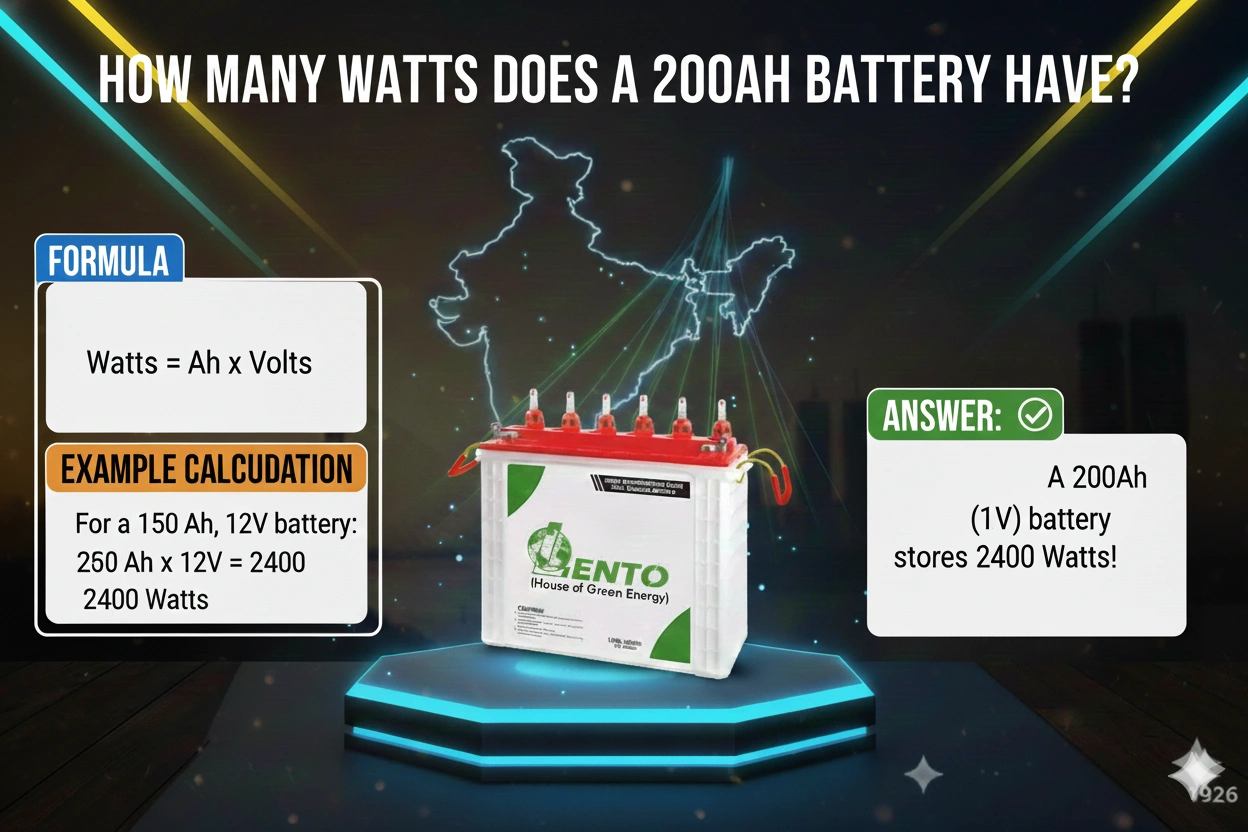
Watts = Ah × Voltage
For our case:
Watts = 200Ah × Battery Voltage
But battery voltage varies. The common voltages used in inverter and UPS systems are:
-
12V (home inverters)
-
24V (medium loads)
-
48V (online UPS and commercial loads)
So the watt capacity of a 200Ah battery depends on its voltage level. Let me calculate each one for you.
200Ah Battery at 12V: How Many Watts?
Most households use a 12V, 200Ah tubular battery with their inverter.
Formula:
Watts = 200 × 12
Watts = 2400 watt-hours (Wh)
This means:
👉 A 200Ah 12V battery stores 2.4 kWh of energy (ideal).
However, actual usable energy is less due to efficiency losses:
-
Battery efficiency (80–90%)
-
Inverter conversion loss (10–15%)
-
Safe discharge limit (50–70%)
So in real life, a 12V 200Ah battery gives 1.7–2 kWh usable energy.
This is the value you should consider for backup calculations.
200Ah Battery at 24V: How Many Watts?
24V systems are often used in small offices, shops, and solar setups purchased from an online UPS supplier.
Formula:
Watts = 200 × 24
Watts = 4800 watt-hours (Wh)
Usable energy (after losses) = 3.4–4 kWh
A 24V system is more efficient and stable compared to 12V, especially when the load is moderately high.
200Ah Battery at 48V: How Many Watts?
Most commercial UPS systems—especially those sourced from an online UPS manufacturer—use a 48V battery bank.
Formula:
Watts = 200 × 48
Watts = 9600 watt-hours (Wh)
This equals 9.6 kWh of stored energy.
Usable energy = 7–8 kWh
A 48V, 200Ah system is powerful enough to support:
-
Server rooms
-
Multiple computers
-
Labs
-
Retail billing systems
-
CCTV setups
-
Medical devices
This is why online UPS traders prefer 48V setups—they deliver high efficiency and excellent backup in commercial environments.
Why You Never Get 100% of Calculated Wattage
One thing I always emphasize to customers:
👉 The calculated watt value is always theoretical.
Real watt output is lower because:
1. Inverter Efficiency
Most inverters deliver 85–95% efficiency.
2. Battery Chemistry
Lead-acid gives only 50–70% usable DoD (Depth of Discharge).
Lithium gives 90–95%.
3. Temperature
High temperatures reduce usable capacity.
4. Cable & Terminal Losses
Energy drops through connections too.
So while a 200Ah 12V battery is 2400Wh on paper, real usable energy is around 1800–2000Wh.
How Long Will a 200Ah Battery Run Different Appliances?
This is the part most users care about!
Let’s calculate backup time using a 12V, 200Ah battery (usable: ~1900Wh).
1. Fans & Lights
-
2 fans = 140W
-
4 LED lights = 40W
Total: 180W
Backup = 1900 ÷ 180
Backup ≈ 10.5 hours
2. TV + Fan + Lights
-
LED TV = 120W
-
1 fan = 70W
-
LEDs = 40W
Total: 230W
Backup = 1900 ÷ 230
Backup ≈ 8.2 hours
3. Refrigerator
Running load = ~200W
Backup ≈ 9.5 hours
4. Computer Setup (ideal for offices)
PC = 150W
Router = 12W
LED = 10W
Total ≈ 172W
Backup ≈ 11 hours
5. 48V System for Businesses
Usable energy ≈ 7500Wh
PC load = 150W
7500 ÷ 150 ≈ 50 PCs (theoretical)
Typically, businesses comfortably run 20–30 PCs with a 48V 200Ah battery bank from an online UPS manufacturer.
200Ah Battery Use in Solar Systems
This capacity is extremely popular in solar installations because:
-
It stores more power
-
Handles higher loads
-
Gives longer backup at night
-
Supports hybrid operations
A 200Ah battery pairs well with:
-
1kW solar systems
-
2kW hybrid systems
-
3kVA–5kVA inverters
Homes, shops, and small offices using solar generally prefer 200Ah batteries because they offer predictable and stable performance even with varying sunlight.
Choosing the Right Inverter for a 200Ah Battery
For maximum performance and lifespan, match the inverter properly.
Home Use
-
12V inverter
-
900VA–1500VA rating
-
Tubular battery (200Ah)
Solar Hybrid Use
-
24V system
-
MPPT charge controller
-
1.5kVA–3kVA inverter
Commercial UPS Use
-
48V UPS
-
SMF or Lithium battery
-
Sourced from an online UPS supplier or trader
Lead-Acid vs Lithium: Which 200Ah Battery Is Better?
It depends on your budget and requirement.
Lead-Acid 200Ah
-
Affordable
-
Heavy
-
Needs maintenance
-
3–4 years life
-
50–70% usable energy
Lithium 200Ah
-
Expensive
-
Lightweight
-
Zero maintenance
-
8–12 years life
-
90–95% usable energy
-
Faster charging
For businesses buying from an online UPS manufacturer, lithium 200Ah is becoming the preferred choice.
Where a 200Ah Battery Is Commonly Used
You’ll find 200Ah batteries in:
-
Homes
-
Schools
-
Shops
-
Hospitals
-
Server rooms
-
Solar power plants
-
Bank ATMs
-
Retail stores
-
Computer labs
-
Online UPS systems
Many UPS and inverter suppliers prefer stocking 200Ah batteries because they offer the best balance of price vs. performance.
Common Mistakes People Make When Calculating Watts
Let me share a few mistakes I see frequently:
-
Assuming 200Ah means 200 × 12 = 2400W usable (not true)
-
Ignoring efficiency losses
-
Overloading the inverter
-
Using the wrong inverter voltage
-
Mixing old and new batteries
-
Buying cheap, low-quality batteries from unreliable sellers
For accurate sizing, always count losses and consider realistic values.
Why Businesses Should Understand Watt Calculations
If you run an office, shop, or manufacturing unit and buy power solutions from an online UPS manufacturer, knowing watt capacity helps you:
-
Prevent overload issues
-
Plan accurate backup time
-
Select the right UPS rating
-
Reduce downtime
-
Increase productivity
-
Lower operating costs
Battery sizing is not just technical—it directly impacts business continuity.
Conclusion
Understanding how many watts a 200Ah battery has is essential whether you’re setting up a home inverter, planning a solar system, or selecting commercial UPS solutions from an online UPS supplier, online UPS trader, or online UPS manufacturer.
A 200Ah battery can store between 2.4 kWh (12V) to 9.6 kWh (48V) of energy, depending on voltage. But real-world usable energy is always lower due to efficiency losses. Knowing this helps you calculate backup time accurately and choose the right inverter, battery bank, and system voltage.
A properly sized backup system doesn’t just provide electricity—it provides peace of mind, stability, and safety for your family or business.